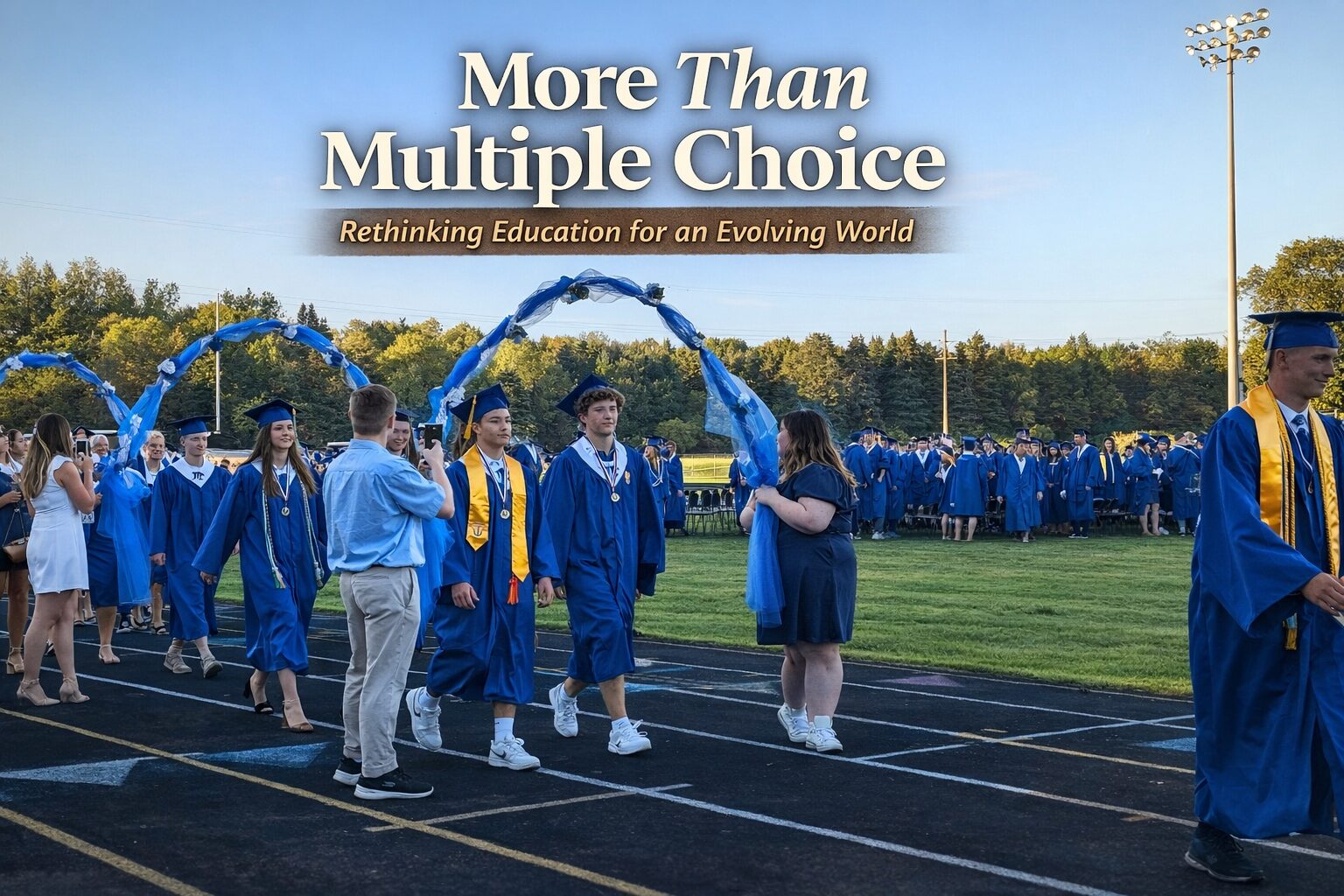
Earlier this week, I found myself sitting in the Playhouse of White Lake for a screening of the documentary Multiple Choice, hosted by MAISD. It was a great turnout. Local leaders, educators, parents, and community members all gathered for a shared experience that, at first glance, felt like just another conversation about education. It wasn’t.
What the film captured, and what stayed with me afterward, was something deeper. It put words and examples around a growing realization that many of us have felt but maybe have not fully articulated. Our education system is increasingly out of sync with the world our kids are stepping into. And that gap is about to widen.
One of the opening ideas in the film was direct and hard to ignore. We should not underestimate the power of artificial intelligence. It is already capable, and it is improving quickly. More importantly, it is especially well suited to handle the kind of work we have historically trained students to do.
For years, success in school has followed a familiar pattern. Learn the material. Follow instructions. Produce the correct answer. Perform well on tests. Build a transcript that leads to college.
That model made sense in a different era. Today, it creates a problem.
If we have spent twelve or more years training students to be excellent at following instructions and producing predictable outputs, and now machines can do that faster and often better, we have to ask a difficult question. What exactly are we preparing them for?
The film does not suggest that education is failing entirely. It does, however, challenge the assumption that there is one primary path to success. For decades, that path has been clear. Go to college, earn a degree, and the rest will take care of itself.
But reality has become more complicated. Many students start college and never finish. Others graduate with significant debt and struggle to find work that aligns with their degree.
The issue is not that college lacks value. It absolutely does for many people. The issue is that we have elevated it to the point where it is seen as the only respectable option.
In doing so, we have unintentionally created a divide. There are those who “think” and those who “do.” Academic paths are often viewed as superior, while hands-on or technical paths are treated as a fallback.
The film makes a strong case that this distinction is not only outdated, but damaging.
One of the most compelling parts of the documentary takes place in Winchester, Virginia, where a high school has reimagined how students learn. Instead of separating academic and career paths, they integrate them. Students are exposed to real-world work while still engaging in rigorous academics. They build, design, weld, care for patients, and solve problems, all while learning the underlying theory that supports those activities. The result is not a reduction in academic quality. It is an increase in engagement, clarity, and confidence.
You see students who previously struggled in traditional classrooms come alive when they are given the opportunity to work with their hands. You see others who plan to attend college become more well-rounded, more grounded, and more certain about their direction. In many cases, students simply discover what they do not want to do. That alone is valuable. Because exposure creates clarity. And clarity leads to better decisions.
What becomes obvious is that the purpose of school cannot simply be to prepare students to be good at school. At some point, it has to prepare them for life. That sounds obvious, but our current system does not always reflect it.
We measure success through test scores, graduation rates, and college placement. Those metrics are easy to track, but they do not tell the full story. They do not capture whether a student can solve real problems, work effectively with others, adapt to change, or create value in a real-world environment.
At the same time, employers are signaling a clear disconnect. There are millions of unfilled jobs, yet many graduates are underemployed. The issue is not a lack of intelligence. It is a mismatch between what is taught and what is needed.
Artificial intelligence is going to accelerate that mismatch. The jobs most exposed to disruption are those that are repetitive, rules-based, and entirely digital. In other words, the exact type of work that aligns with how many students have been trained to succeed.
The future will reward something different.
It will reward people who can think critically, apply knowledge, collaborate with others, and adapt as conditions change. It will reward those who can both understand concepts and execute in the real world. That is not a choice between college and career. It is a recognition that the best preparation includes both.
What I appreciated most about the “Multiple Choice” event was that it was not just about watching a film. It was about bringing a community together to think about what comes next. Because this is not just an education issue. It is a community issue. When students graduate with direction and capability, they contribute differently. They build businesses. They fill critical roles. They strengthen the local economy. They create stability and opportunity for others. When they do not, the consequences ripple outward.
The answer is not to abandon academics. It is to expand the definition of what education should include. It is to give students opportunities to explore, to build, to fail, to adjust, and to discover what they are capable of doing.
For too long, we have given students multiple choice tests and called it preparation.
What they actually need are multiple choices in life.
And that is a very different conversation.