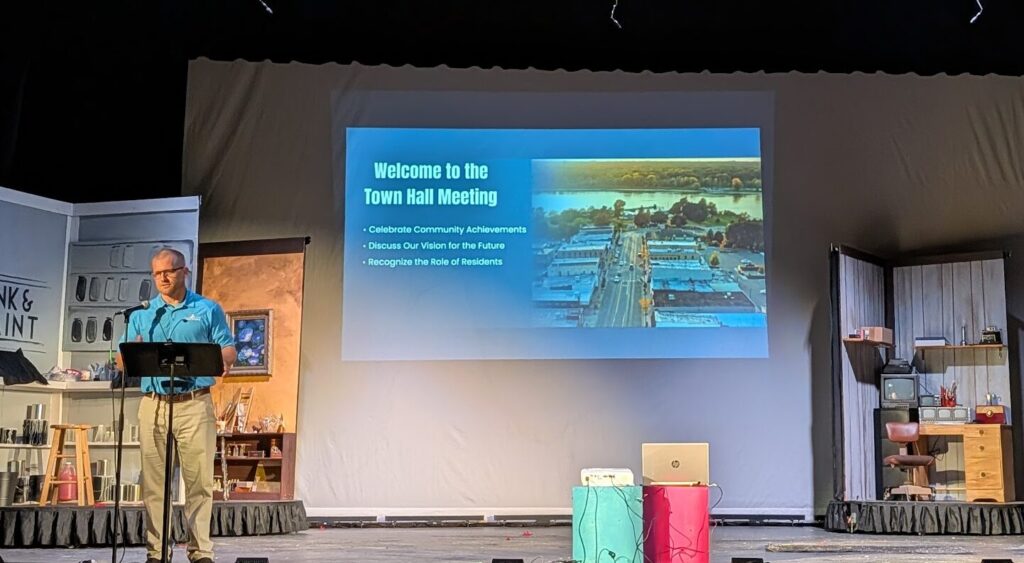
WHITEHAL — Whitehall City Manager Dan Tavernier used Whitehall’s town hall meeting Monday evening to do more than provide project updates. He invited residents into the reasoning behind city decisions, emphasizing that understanding how and why decisions are made is just as important as whether everyone agrees with them.
Held at The Playhouse at White Lake, the meeting marked one year since Tavernier became city manager and offered residents an opportunity to hear directly from city leadership, ask questions, and discuss priorities shaping Whitehall’s future.
Throughout the evening, one message remained consistent.
“Residents deserve to be heard, even when we don’t always agree,” Tavernier said, explaining that transparency and accountability are central to how he approaches the job.
Rather than focusing only on completed projects, Tavernier outlined a broader vision centered on strengthening infrastructure, supporting economic growth, improving parks, and maintaining Whitehall’s character while preparing for future development.
Investing Below Ground Before Building Above It
While residents often notice new sidewalks, parks, and road improvements, Tavernier argued that some of the city’s most important investments are the ones people never see.
He identified aging water, sewer, and stormwater infrastructure as Whitehall’s highest priority, particularly the replacement of the Lake Street lift station, which serves much of the city’s wastewater system. He noted that completing underground work before resurfacing streets prevents taxpayers from paying to tear up newly rebuilt roads later.
Tavernier also discussed the city’s use of general obligation bonds to finance major infrastructure projects. While borrowing increases costs through interest, he said delaying construction often proves even more expensive as material and labor costs continue to rise.
“Our costs are not going down,” Tavernier told residents, explaining that completing projects sooner often saves money over the long term while allowing residents to benefit from improvements earlier.
Using Data to Prioritize Road Projects
Tavernier also explained how the city determines which roads become priorities for reconstruction.
Using Whitehall’s PASER road rating map, he showed residents how city staff evaluate pavement conditions across the community. The statewide PASER system rates roads based on their condition, helping communities identify which streets require preventive maintenance and which have deteriorated to the point where full reconstruction becomes the most cost effective option.
Rather than relying solely on public complaints or visible pavement conditions, the city compares PASER ratings with other factors, including underground utility needs, lead service line replacements, traffic patterns, and available funding. The goal, Tavernier explained, is to coordinate projects whenever possible so roads are rebuilt only once instead of being excavated again for future utility work.
See the City of Whitehall’s 2025 PASER Ratings below:
Major Road Projects Begin Taking Shape
Representatives from Prein&Newhof provided an overview of the Muskegon Avenue and Livingston Street reconstruction projects, which will include complete roadway reconstruction, new water mains, storm sewer improvements, and replacement of lead service lines.
Engineers said every lead or galvanized service line identified within the project areas will be replaced all the way into the home at no cost to property owners. Replacement materials will include copper and PEX piping.
Construction is expected to begin in spring 2027 following completion of design work and bidding, with crews working around the school calendar to minimize disruptions near Whitehall schools.
Officials also acknowledged that some tree removals may be necessary because of underground utility conflicts, though replacement trees are planned as part of the projects.
Tavernier said replacing lead service lines remains one of the city’s long term priorities as Whitehall works toward the state’s 2037 replacement deadline.
See the City of Whitehall’s Lead Service Lines map below:
Paying Today’s Prices Instead of Tomorrow’s
One topic that generated significant discussion involved the city’s recent use of general obligation bonds to accelerate infrastructure improvements.
Tavernier explained that the bonds do not increase property taxes and are being repaid through existing revenue sources rather than new taxes.
While borrowing increases overall project costs through interest, he argued that waiting several years could ultimately cost taxpayers even more because construction prices continue to rise.
The city received approximately $900,000 in additional proceeds during the bond sale, providing additional funding for capital improvements while allowing Whitehall to move projects forward sooner rather than delaying them until enough cash had accumulated.
He acknowledged that construction estimates have risen dramatically in recent years and said staff has had to creatively combine funding from multiple sources to keep projects moving.
Supporting Businesses Through Grants and Partnerships
Economic development was another major focus of the presentation.
Tavernier described Whitehall as a city that wants to encourage investment, pointing to several grant and incentive programs designed to help businesses improve their properties.
Those efforts include facade improvement grants, Commercial Rehabilitation Act tax abatements, Match on Main grants, and a new Local Development Finance Authority grant program that helps industrial businesses complete life safety improvements.
One recent success involved securing a $25,000 Match on Main grant from the Michigan Economic Development Corporation for the White Lake General Store, along with an additional $2,500 local contribution. Tavernier noted, however, that because the business has since closed, the city is awaiting guidance from the state before any grant funds are distributed.
Parks Become the Next Long Term Conversation
While infrastructure remains the city’s highest priority, Tavernier also shared early ideas for future park improvements.
Among the concepts discussed were a BMX style pump track at Funnell Field, upgraded playground equipment at Goodrich Park, additional amenities at Svensen Park and Mill Pond, and expanded garden space at Slocum Park.
He emphasized that many of those ideas remain conceptual and will ultimately be shaped through an updated Parks and Recreation Plan with significant public input.
Residents later echoed the importance of involving the community as future park priorities are developed.
Residents Raise Questions About Accountability, Safety, and Quality of Life
The second half of the evening shifted almost entirely to audience questions, covering topics ranging from delayed construction projects to traffic safety and environmental sustainability.
Several residents questioned the delayed completion of the West Colby Promenade project and whether penalties outlined in the construction contract would be enforced.
Tavernier said the city is currently withholding payments while working with the contractor to complete the remaining work, explaining that his primary goal is getting the project finished rather than immediately pursuing financial penalties.
Questions also focused on pedestrian safety near parks and schools, speeding along Colby Street, noise from vehicles and motorcycles, electric bicycles, tree maintenance, recycling, sustainability initiatives, marina funding, and future park improvements.
Public safety was another recurring topic.
Police officials said the department has significantly increased traffic enforcement over the past year, with citations roughly doubling compared to the same period last year. They said the goal is preventing crashes and protecting pedestrians rather than generating revenue.
Residents also asked about emergency medical response times, prompting Tavernier to discuss ongoing conversations with White Lake Ambulance Authority regarding future service capacity.
Building Trust Through Conversation
While the evening covered dozens of individual topics, the larger purpose extended beyond project updates.
Tavernier repeatedly encouraged residents to ask questions, challenge decisions, and stay engaged with city government.
“You may not always agree with every decision, but you should always understand why it was made,” he said.
He also welcomed accountability, telling residents, “I’m the blame line,” while encouraging people to contact him directly whenever they have concerns about city projects or decisions.
The town hall represented a different kind of public meeting than a traditional council session. Instead of debating agenda items, city leadership focused on explaining the reasoning behind long term planning and inviting residents into that process.
As Whitehall prepares for years of road reconstruction, infrastructure upgrades, and park planning, Monday night’s discussion suggested that the city hopes future progress will be measured not only by completed projects, but also by how well residents understand the decisions that shape them.
CatchMark Community is more than a weekly read. It’s an ongoing conversation. Follow along on social media for daily stories, local highlights, videos, and moments from around the White Lake area.
Facebook • Instagram • YouTube • TikTok • LinkedIn • X
Stay connected to what’s happening in our area by visiting CatchMark Community.
Powered by CatchMark Technologies — helping people, solving problems. Explore more on our website.