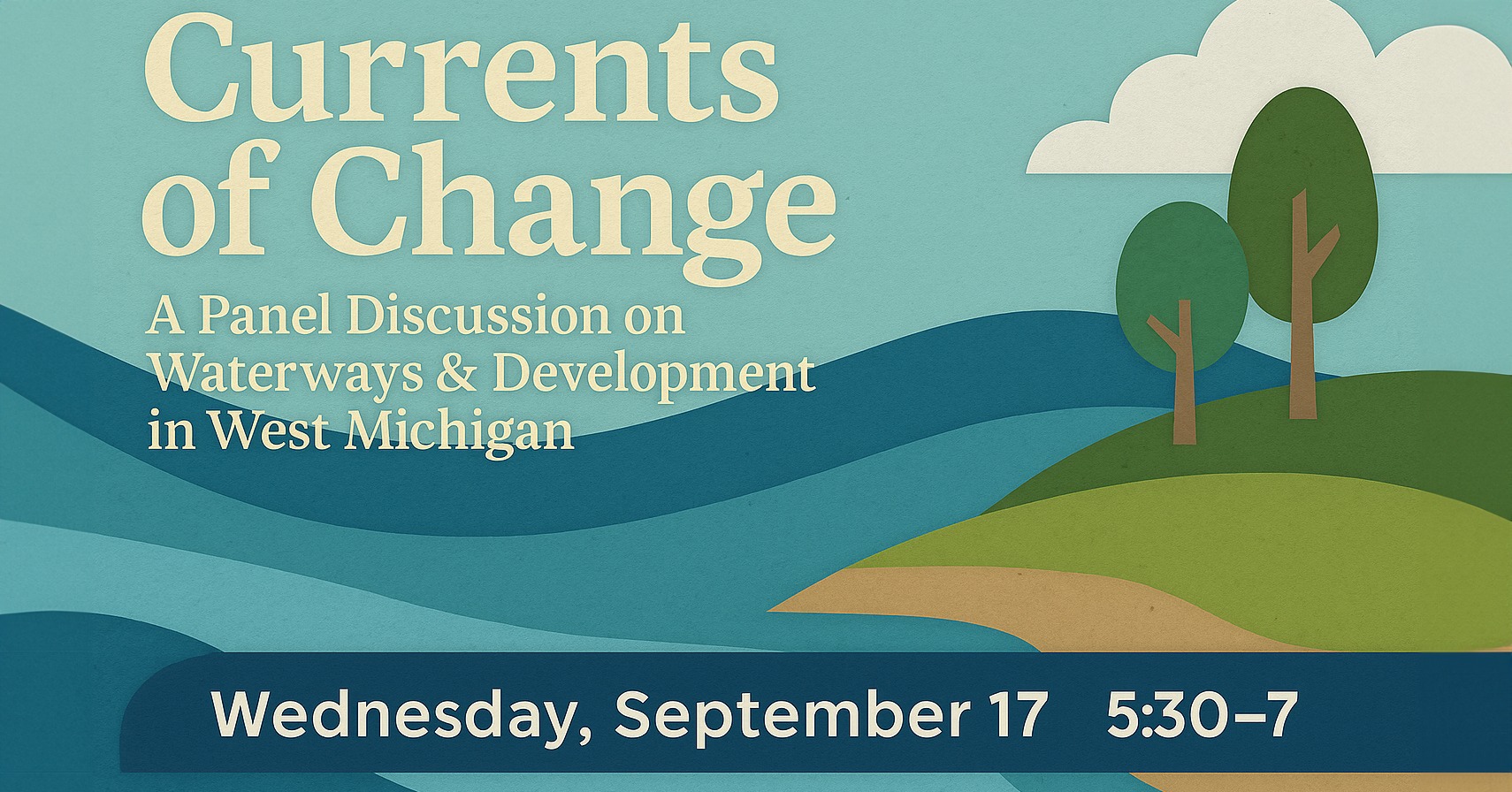
Event: Sept. 17, 2025 • 5:30–7:00 p.m. • White Lake Community Library
White Lake Community Library was buzzing Wednesday night as neighbors, students, scientists, and civic leaders pulled chairs close for an honest talk about something that defines life here as surely as the seasons: water. “Shared Waters,” a three-part series co-presented by regional libraries and WGVU with support from the Community Foundation for Muskegon County, launched with Currents of Change, a moderated panel on the push-and-pull between development and the rivers, lakes, and wetlands that shape West Michigan.
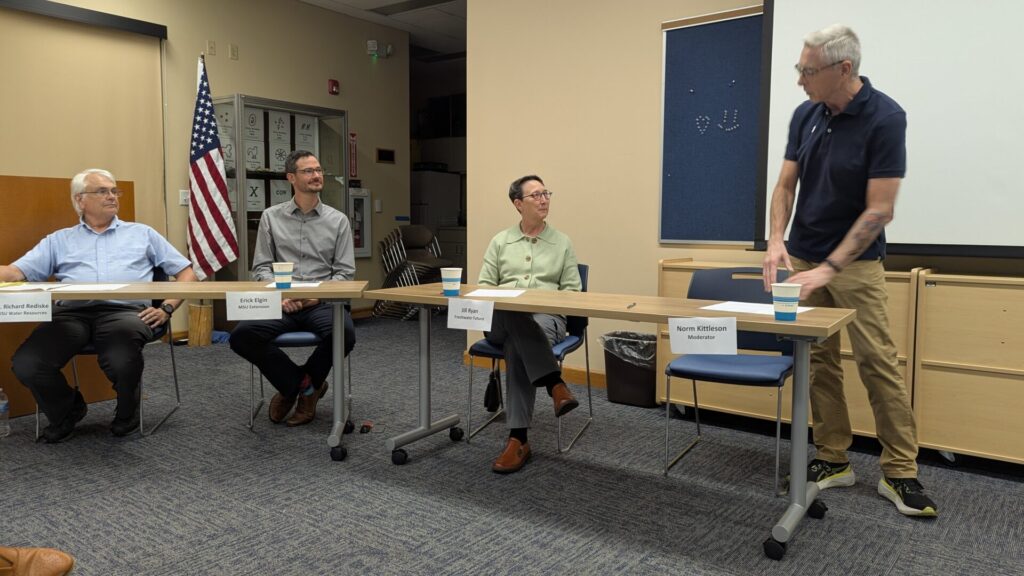
Moderator Norm Kittleson set a welcoming tone and guided a fast-moving discussion with panelists Jill Ryan (Freshwater Future), Dr. Rick Rediske (Emeritus Professor, GVSU’s Annis Water Resources Institute), and Erick Elgin (MSU Extension). Their message was clear: our waterways built this region, and our choices now will determine whether they can keep sustaining us—ecologically, economically, and culturally—into the future.
“Water built this place”—and it still does
Panelists traced a simple arc: industry and communities rose along water because it moved goods, powered mills, and supplied farms and cities. That legacy remains visible everywhere—from channelized shorelines and legacy dams to pockets of contamination that took decades to remediate.
Today, cleaner lakes and rivers make waterfronts even more desirable. That creates two obligations, the panel argued: protect public access and avoid repeating old mistakes.
“We’ve spent years and millions restoring places like White Lake and Muskegon Lake. As demand returns, we need guardrails so we don’t re-create the very problems we just solved.” — Jill Ryan
Development pressure, real impacts
The conversation got specific about what “pressure” looks like on the ground:
- Shoreline hardening & habitat loss. Replacing trees and native plants with lawns, driveways, and seawalls accelerates erosion and strips habitat for turtles, frogs, birds, and fish. Individually small choices add up to cumulative impacts around an entire lake.
- Nutrients & pathogens. Dense development and poorly managed runoff mean more nitrogen and phosphorus reaching the water (fueling nuisance algae) and more E. coli from septic failures, pet waste, and urban wildlife—issues often documented in Total Maximum Daily Load (TMDL) plans for local tributaries.
- Wetlands on the bubble. Wetlands slow floods, filter pollutants, and nurture wildlife. Policies and enforcement vary, and panelists noted recent rollbacks and “after-the-fact” permits can erode protections. Once filled, function is hard to replace—man-made wetlands rarely match the originals.
- Dams & tradeoffs. Legacy hydropower dams fragment rivers and block fish passage; removal or retrofits carry major costs and ripple effects. “If a dam stays, we must budget to maintain it. If it goes, we need a plan for communities upstream and down,” Ryan said.
- Climate whiplash in real time. After recent high-water years, parts of West Michigan are seeing lower precipitation and shallow groundwater down several feet, Elgin said. That affects lakes fed by groundwater and underscores how quickly conditions can swing—and why flexible, nature-based infrastructure matters.
What communities can do (and people, too)
Solutions came in two flavors: policy and personal.
Policy & planning
- Conservation-minded development. Planning commissions can require open-space set-asides, conservation easements, and native buffers along waterways. Cluster homes away from sensitive areas instead of parceling wetlands into private yards.
- Keep public access public. As shoreline parcels change hands, local governments should bargain for community benefits: trail corridors, launch sites, and overlooks.
- Think watershed-wide. Stormwater ordinances that slow, spread, and soak (rain gardens, permeable pavement) protect downstream rivers and beaches.
“Local government runs on informed citizens. Show up. Serve. You’d be surprised how much positive change you can help steer.” — Rick Rediske
Everyday actions that add up
- Plant native trees and shrubs; keep a natural shoreline strip. It slows runoff, stabilizes banks, and blocks invasives.
- Use less salt in winter and skip spring nitrogen bursts. Everything on a street or sidewalk heads to a storm drain—and then to a stream.
- Maintain septic systems. It’s out of sight, not out of the watershed.
- Join a workday with your local conservation district, watershed group, or Friends-of-the-Lake association.
“Collectively, small decisions make resilient lakes. I’m optimistic—we’re on a good trajectory if we keep at it together.” — Eric Elgin
Student spotlight: Ravenna FFA Stream Team
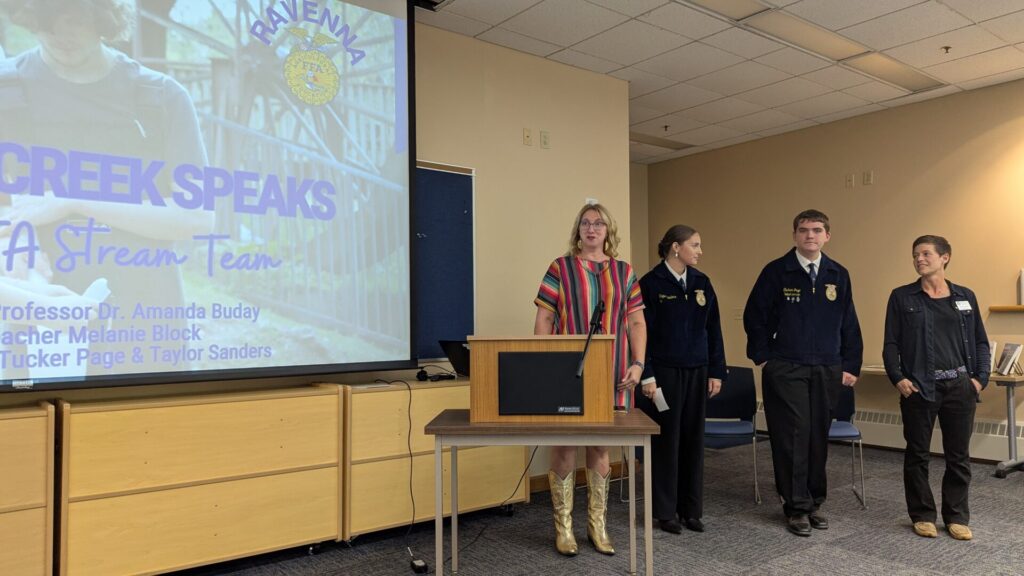
Before the panel, the audience heard from the Ravenna High School FFA Stream Team, led by Agri-science teacher Melanie Block with guidance from GVSU’s Dr. Amanda Buday. Students sample Crockery Creek at four sites, tracking temperature, pH, conductivity, salinity, turbidity, flow, and macroinvertebrates (those tiny “bugs” that reveal stream health). With upgraded field gear, standardized data sheets, and an online dashboard, the team is building a trusted, local dataset the community can use year after year.
Their practical lesson? Science is iterative, equipment expires (sometimes before the students were born!), and better tools + consistent methods = better data. Also: warm waders are worth it.
What’s next in “Shared Waters”
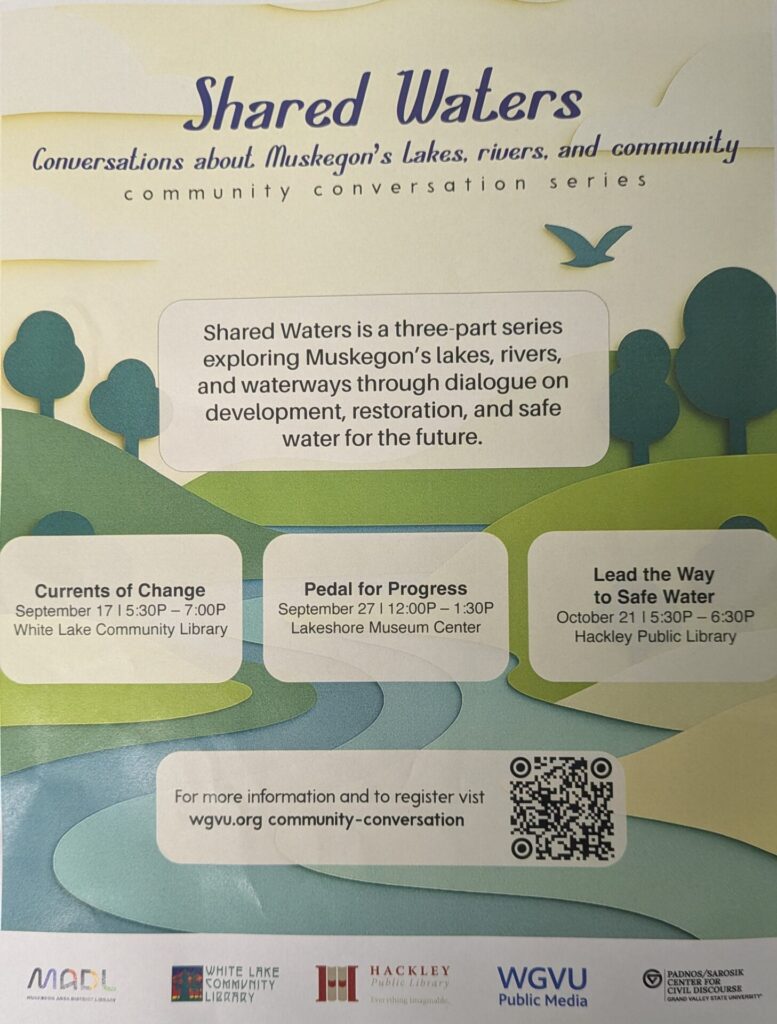
This was the first of three community conversations produced by White Lake Community Library with partners Muskegon Area District Library, Hackley Public Library, Grand Valley State University’s Padnos/Sarosik Center for Civil Discourse, and WGVU Public Media; funding from The Community Foundation for Muskegon County.
- Event 2: A guided bike ride along Muskegon Lake with speakers and discussion stops.
- Event 3: At Hackley Public Library, a program on testing for lead in water, featuring experts and practical how-tos.
Details and registration are available via partner calendars and WGVU’s community page. As always, programs are free and open to all. (Shout-out to Colby’s Café for the tasty refreshments this week.)
This series also ties into the NEA Big Read Lakeshore initiative, inspired this year by Leif Enger’s I Cheerfully Refuse, Christina Soontornvat’s A Wish in the Dark, and Aaron Becker’s Journey—books that invite us to consider place, stewardship, and the worlds we build together.
A final word—and an invitation
White Lake Community Library is celebrating 25 years in its current building on October 17. If you enjoyed the conversation (or the snacks), come back, bring a friend, and keep the dialogue going. West Michigan’s waters have carried us far. With a little planning, a lot of partnership, and the steady work of engaged neighbors, they’ll keep carrying us—clean, accessible, and alive—for generations.
Stay connected to what’s happening in our area by visiting CatchMark Community.