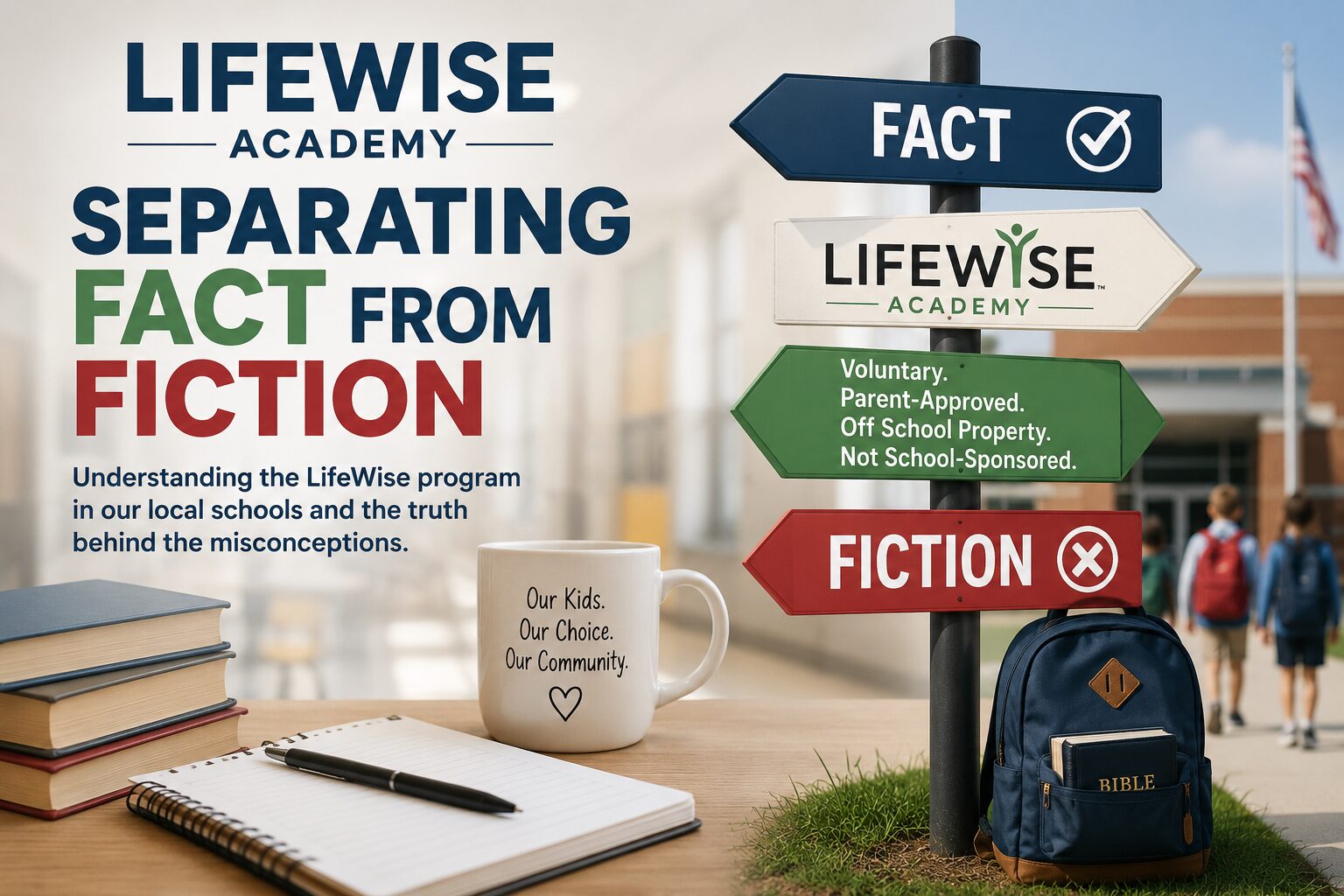
LifeWise Academy: Separating Fact from Fiction
LifeWise Academy has become a topic of discussion in local school districts. Because it involves children, schools, faith, and public education, people have strong opinions.
That is understandable.
However, the community should understand the facts before debating the program.
Some people believe LifeWise is a school-sponsored Bible class. That is not correct. LifeWise is not part of the public school curriculum. Public school teachers do not teach it. The district does not require students to attend. Tax dollars do not fund the religious instruction.
Instead, LifeWise is a private, nonprofit program. It offers Bible-based character education to students whose parents choose to enroll them.
What LifeWise Is
LifeWise operates under released time religious instruction.
This allows a student to leave public school during the school day for religious instruction at another location. In Michigan, this can happen only under specific rules.
First, a parent or guardian must give written permission. Also, the instruction must happen off school property. The time away from school is limited. In addition, district procedures still apply for attendance, safety, transportation, and scheduling.
That distinction matters.
LifeWise is religious. Its lessons are Bible-based. Its content is Christian. Even so, the program is not a school-run Bible class. It is optional for families who choose it.
What LifeWise Is Not
LifeWise is not mandatory.
No student has to participate. Families who do not want the program can simply decline.
Also, the school does not sponsor the religious instruction. A district may allow students to leave at an approved time, but LifeWise teaches the lessons off campus. The program sits outside the district’s academic curriculum.
In plain terms, the school is not teaching Christianity. The district is not creating a Bible class. LifeWise does not replace public education.
The school’s role stays limited. The district manages its schedule, records, and policies. Meanwhile, LifeWise manages its own program.
Why the Confusion Matters
Misunderstanding creates division.
When people call LifeWise “religion in public school,” they give the wrong impression. The lessons do not take place in a public school classroom. Also, the school does not teach them. The district does not add them to its curriculum.
Supporters need clear language too. They should not suggest that the school endorses or promotes LifeWise. Public schools must remain neutral.
That balance protects everyone.
It protects families who want the option. It also protects families who do not. Most importantly, it protects the district from appearing to favor or oppose religion.
Parent Choice Comes First
Parent choice sits at the center of this issue.
Parents decide whether their children participate. The school does not make that choice. Other parents do not make that choice. Community groups do not make that choice either.
Of course, parents and residents can still ask fair questions.
They can ask when students would leave school. They can ask what class time students would miss. They can ask who provides transportation. They can ask who supervises students. Attendance procedures should also be clear. So should the treatment of students who do not participate.
These are reasonable questions. A good district should answer them.
However, those questions are different from saying LifeWise should be rejected because it is religious.
Why Districts Should Be Careful
School districts need to respond carefully.
A district may set rules for outside programs. It can protect instructional time. It can require safe transportation. It can limit disruptions. It can make sure students receive proper supervision.
Those rules make sense.
Still, the district should apply them fairly.
Many schools already interact with outside programs. Students may leave for medical appointments, counseling, career programs, dual enrollment, vocational training, internships, therapy, mentoring, athletics, or other parent-approved activities.
That does not mean every outside program must receive approval. However, it does mean districts should use consistent standards.
If a district allows other parent-approved opportunities but rejects LifeWise because it is Christian, the district creates a bigger problem. Public schools cannot sponsor religion. At the same time, they should not show hostility toward religion.
Neutrality works both ways.
Consistency Matters
The better question is not, “Do we agree with LifeWise?”
The better question is, “Does LifeWise meet the same neutral standards we apply to similar programs?”
That is the fair approach.
For example, when missed class time creates concern, the district should review all programs that pull students from class. When transportation creates concern, the same transportation rules should apply to everyone. When student safety creates concern, every outside program should provide a clear safety plan.
But when the concern is only that LifeWise is Bible-based, the issue changes.
At that point, the debate becomes less about policy and more about viewpoint.
The Risk of Shutting It Down
Some opponents may think they are asking the district to stop one program. However, the impact could reach much further.
A district that blocks LifeWise may need to review other outside programs too.
For example, should students leave during the school day for other activities if they cannot leave for LifeWise? Should outside organizations work around the school schedule if LifeWise cannot? Should instructional time concerns apply only to LifeWise, or should they apply to every program?
These questions matter.
One standard for religious programs and another for nonreligious programs invites conflict. It also weakens public trust.
Clear, neutral rules work better.
A Fair Path Forward
There is a practical path forward.
The district can stay neutral. Parents can decide for their own children. LifeWise can operate only if it follows the law and district policy. Students who do not participate can continue their normal school day without pressure or stigma.
This approach does not force religion into public school. It also does not exclude religious families from a lawful, parent-directed option.
It respects public education. It respects parental rights. It also respects families who want no part of the program.
The Conversation We Need
People can still disagree about LifeWise.
Some families will see the program as a helpful way to reinforce faith, values, and character. Others will worry about missed class time, fairness, or the connection to the school day.
Those concerns deserve discussion.
However, the discussion should stay grounded in facts. LifeWise is not a mandatory school Bible class. The district does not teach it. The program is not part of the public school curriculum.
Rather, it is an optional, parent-approved, off-campus program.
Separating Fact from Fiction
Small communities depend on trust.
Rumors and assumptions make hard conversations harder. Better conversations start with clear facts, fair questions, and consistent standards.
LifeWise may not be right for every family. It does not need to be.
Families who want the option should not be misrepresented. Districts should not face pressure to reject a lawful program only because some people disagree with its religious content.
The best answer is simple.
Schools should stay neutral. Parents should decide. Districts should apply consistent rules. Our community should deal in facts rather than fiction.
Follow along on social media for daily updates, community highlights, and moments that happen between the headlines.
Facebook • Instagram • YouTube • TikTok • LinkedIn • X
Stay connected to what’s happening in our area by visiting CatchMark Community.
Powered by CatchMark Technologies — helping people, solving problems. Explore more on our website.

Brent is the Managing Partner of CatchMark Technologies and a seasoned technologist with over 25 years of experience in IT leadership, cybersecurity, and technical operations. He began his career serving in the U.S. Army, where he worked extensively with electronics—laying the foundation for his lifelong passion for technology and problem-solving. Brent holds a Certified Information Systems Security Professional (CISSP) certification and currently leads CatchMark’s Cybersecurity and Tech Support teams. Known for his strategic thinking and hands-on expertise, he excels in guiding secure, scalable solutions and driving innovation across complex technical environments.
2 Comments
Leave a Reply
Cancel reply
Leave a Reply
Must See
-
Community
/ 7 hours agoLifeWise Academy: Separating Fact from Fiction
LifeWise Academy: Separating Fact from Fiction LifeWise Academy has become a topic of discussion...
By Brent Raeth -
Community
/ 13 hours agoWhite Lake Area Historical Society Presents: The History of Boy Scouts in the White Lake Area
Do you recognize any of these Scouts? When and where was this picture taken?...
By Amy Yonkman -
Latest News
/ 2 days agoCatchMark Community Weekly Recap: White Lake Highlights
This week in the White Lake area brought important conversations about the future, strong...
By Amy Yonkman

Kitty Schwanitz
May 18, 2026 at 6:06 pm
Let’s start with what is Release Time for Religious Instruction.
In 1948, SCOTUS struck down religious programs in schools in the McCullum case.
In 1952, SCOTUS upheld it if it satisfied 4 requirements: Off school property, not using tax payer resources, with parent permission, and with the school operating completely neutral and no coercion.
What is LifeWise Academy? Born out of the idea to McDonaldize orthodox, fundamental Christian Nationalism to the 4 to 14 set to get a wave of new followers and bring the money back to the aligned churches. The mission is simple: Recruit on school grounds using children’s desires for food and to feel special with food treats and prizes. Going after the “unchurched” per their own promotional materials. They have used car line-ups or soccer games.
This approach is very unlike ANY RTRI program before with slick programming and 30 pages of merchandise to brand and sell all the kids.
In Michigan, RTRI programs can take away TWO HOURS of education time per week.
There’s ZERO oversight in the law to protect from predators or where these programs can happen. In Indiana and Ohio there have been programs that met in people’s houses or in board rooms where convicted child molesters worked.
There’s also no oversight on what kind of background check is happening. Background checks are like nets. Most churches use small nets with giant holes. LifeWise Academy started with “Protect my Ministry” a glorified consumer level check that when a activist checked it found that LOWES did a better job than Protect my Ministry did. LifeWise moved to “ProScreening LLC” a similar 3rd party with a similar reach. This is not any of the repudiated agencies that major businesses use. Still LifeWise had made tens of millions of dollars in profit, year after year.
The agenda behind LifeWise is to destroy public education and the easiest way to is disrupt and destroy the separation of church and state. How do you best do that? With obfuscation and confusion.
If a child learns in LifeWise about Creationism as if it were FACT, they will come to science class and be confused. After all, LifeWise occurs DURING SCHOOL HOURS (the motto isn’t strangely – “bringing kids to Christ” and if we are honest, it’s more like “bringing the money to Joel Penton”) and is presented in the same weight as science. It all blends together.
What happens in schools where the school steps WELL over the line? Where LifeWise staff mingle and participate in school events? Where they bring teachers gifts? Where students (or even LifeWise staff) give other students bribes to come? They have 90% participation rates. The WHOLE school empties out leaving only a few kids, which were called “LifeWise Leftovers” in a school email, to sit with ipads losing over 40 hours of learning. That’s the goal.
As a parent, is this FAIR? What if it were your student in a Muslim-majority school? Crying and asking to just pretend to learn about Islam so they could go with their friends and have treats? This happened to MANY Jewish students.
Then there’s the learned antisemitism with the antisemitic tropes.
All of this NEEDS to be presented along with the information you presented.
I agree, schools NEED to be neutral. The many violations will bring the end of RTRI someday and I look forward to it.
I believe that ALL RTRI needs to end. Education time should be for education. Outside programs can’t be exclusionary like religious ones are. Schools should not be hostile to religion but religious programs can’t be hostile to students either. Freedom of and from. RTRI programs must at their foundation RESPECT public education- LifeWise by it’s founder’s OWN WORDS (he agreed in 2024 with the Center for Christian Virtue that he was okay with the end of public education.) that he favored abolishment. His own children are homeschooled.
My words aren’t a directive but a warning and a hope that parents just don’t see Christian and trust.
Brent Raeth
May 18, 2026 at 9:16 pm
I appreciate your perspective, but I think several of these claims need to be separated into fact, opinion, and assumption.
First, I agree that schools need to remain neutral. Public schools should not sponsor religious instruction, pressure students to participate, or treat students differently based on faith. That is exactly why released time religious instruction has clear boundaries. It must be parent-approved, voluntary, off school property, and outside the public school curriculum.
Where I disagree is with the implication that LifeWise itself should be held responsible for every possible social issue that may occur among students. Children feeling left out, peer pressure, teasing, treats, friend groups, or inappropriate comments are not unique to LifeWise. Those things happen every day in schools around sports, clubs, field trips, birthday parties, lunch tables, advanced classes, social groups, and family beliefs. That does not make bad behavior acceptable. It simply means the district should address the behavior directly rather than use it as a reason to eliminate one lawful, parent-directed program.
If a student bullies another student, that should be handled under the school’s conduct policies. If a student makes an antisemitic comment, that should be taken seriously and addressed immediately. If a student pressures another student about religion, that should also be corrected. But those are student behavior issues. They are not automatic proof that the entire program is unlawful, harmful, or should be shut down.
I also think some of the broader claims are overstated. Saying that “many violations” will bring the end of released time religious instruction is speculation. Saying all RTRI should end is a policy opinion, not a factual correction. Saying religious programs are inherently exclusionary ignores the basic reality that many optional programs are selective, interest-based, belief-based, skill-based, or family-choice-based. Not every student participates in every activity, and that alone does not make a program improper.
I also would be cautious about claims regarding the founder’s personal views, homeschooling choices, or alleged desire to end public education unless those claims are supported by direct quotes and full context. We should not ask people to reject exaggeration and misinformation on one side while accepting it on the other.
The fair standard is simple. LifeWise should not receive special favor because it is Christian, but it also should not receive special hostility because it is Christian. Districts should apply the same neutral rules they would apply to any comparable outside, parent-approved program. Those rules should address safety, transportation, attendance, supervision, student conduct, and instructional time.
Parents should absolutely review the program before signing their children up. That is their responsibility. But parents who choose LifeWise should not be portrayed as careless, and districts should not be pressured to reject a lawful program based on assumptions, worst-case scenarios, or opposition to religious content.
The solution is not to shut down every program that may create social differences among students. The solution is to keep schools neutral, let parents make informed choices, and hold all students and programs to clear, consistent standards.