On a Tuesday evening at White Lake Community Library, the room felt familiar in a way many of us did not exactly want it to. People nodded when the speaker asked about stress. More nodded at anxiety. A few smiled at “wired and tired.”
Not because anything was wrong with the people in the chairs, but because a lot of what is happening outside the room has been pressing in on all of us, day after day, headline after headline.
That is why Common Ground Community of White Lake hosted “Handling Anxiety, Stress, and Depression in Uncertain Times” on March 3, featuring guest speaker Lisa Cobb, LMSW, LLC. Common Ground Community formed less than a year and a half ago with a clear purpose: rebuild trust and safety in the White Lake Area through education, dialogue, and mutual support, without pushing a party line. Their goal is to welcome people with all backgrounds and beliefs, and make space for learning, discussion, and real human connection.
On this night, the need was visible.
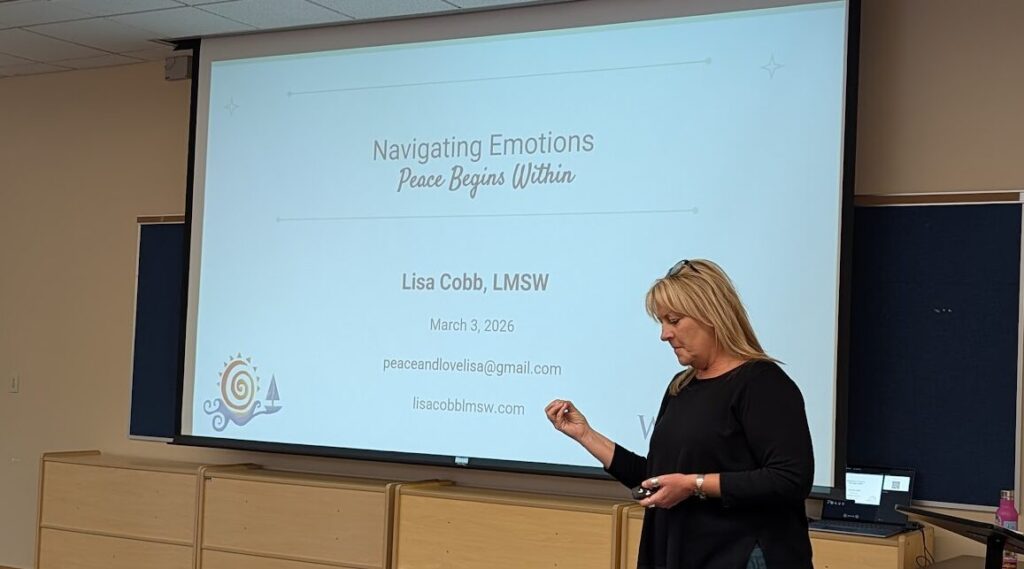
Lisa Cobb
Why this mattered now
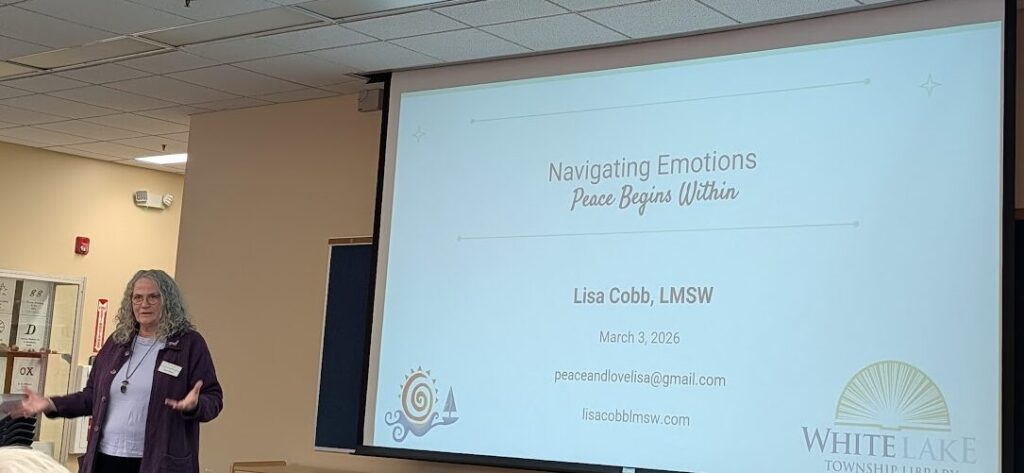
Sue Mack, one of the organizers, opened with the reason Common Ground exists. They saw growing division, conflict, and even hate, and it did not match the community they know White Lake to be. The group kept coming back to one idea: if we want a healthier community, people need actual information and a place to process it together. Mack spoke about how algorithms can trap us in reinforcing loops, and how quickly rabbit holes form when fear and misinformation collide.
But the evening was not just about information. It was about what constant information does to the body.
Sue named it plainly. What we are exposed to right now is heavy, regardless of where someone lands politically. Their invitation was simple: come anyway. Show up anyway. Learn anyway. Take care of ourselves so we can take care of each other.
Sue Mack, co-organizer of Common Ground Community
A poem that put words to what many were feeling
Before Cobb spoke, local poet Julie Essenberg read a piece that landed like a collective exhale. In it, she described the steady weight of the news and the quiet work of staying afloat: turning off the noise, letting the body soften, calling a friend, not to fix the world, but to stay human inside it.
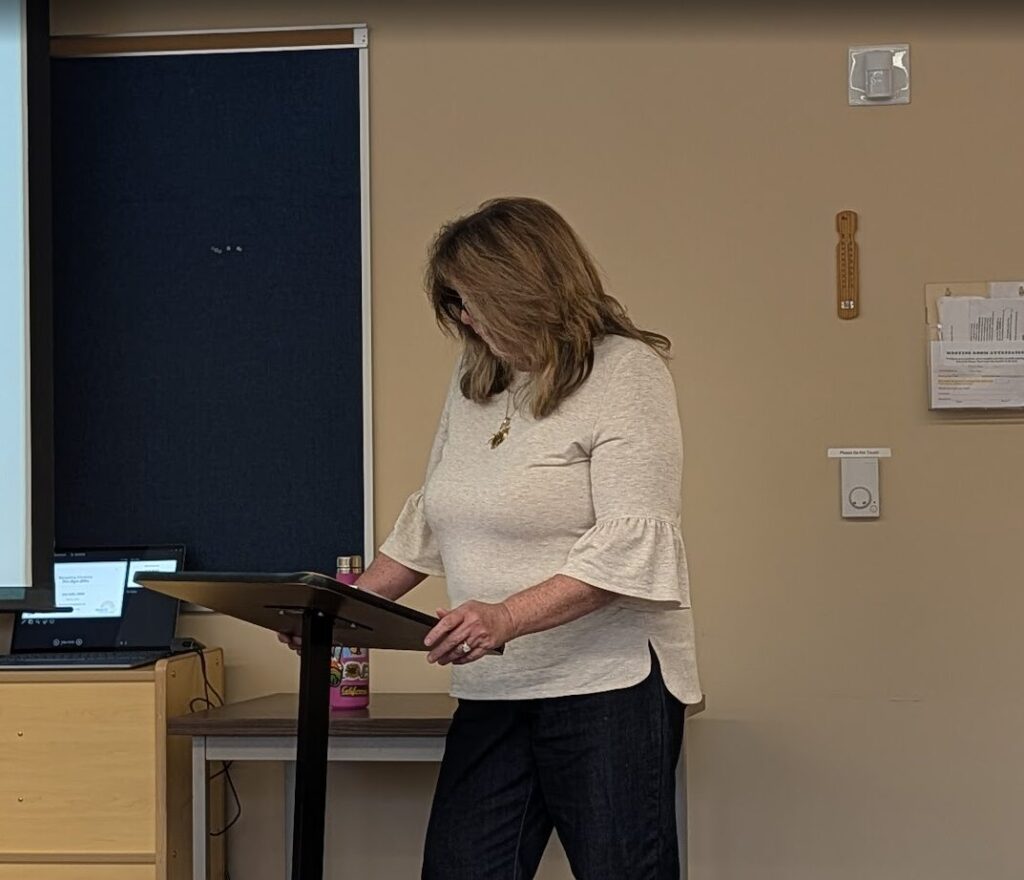
Julie Essenberg reads her poem, Keeping My Head Above Water.
The message was not “ignore reality.” It was that survival takes skill, and skill takes practice.
That theme carried through the entire evening.
“If I stood here and promised you would feel zen every day, it would be a lie.”
Cobb has spent 30 years working in Muskegon County schools with students across age groups and needs. Now she is in private practice and still doing community based work, talking with everyone from hospital staff to construction crews. Her credibility in the room was not just her resume. It was her honesty.
She acknowledged what many people are afraid to admit out loud. We are dysregulated more often than we realize. The shame attached to anxiety and depression does not disappear when we pretend we are fine.
Most of us answer “How are you?” with “I’m okay.” Cobb pointed out that when people finally say the truth, “I can’t sleep, I can’t eat, I feel like I’m losing my mind,” that is when support can begin.
The goal of the night was not perfection. It was relief, a little more steadiness, and a little more hope.
The brain’s job is safety, even when there is no immediate danger
A core thread in Cobb’s talk was this: our brains are wired to treat change like threat, even if we are not in physical danger. The body can react as if we are.
She walked the room through a practical explanation of what happens when we feel unsafe.
The amygdala, our internal bodyguard, constantly scans for danger. The hippocampus checks memory and meaning. It asks if we have experienced this before and what it reminds us of. When the alarm system is triggered, the prefrontal cortex, the wise decision making part of the brain, can go offline.
That is why people snap at partners. It is why many spiral at 3 a.m. It is why doom scrolling can feel irresistible even when we know it makes us feel worse. It is why we replay what we should have said after we calm down. We were not thinking from our best selves. We were thinking from survival mode.
Cobb named the familiar cycle: fight, flight, freeze, and fawn. We see it in kids and give it grace. In adults, it often turns into judgment of ourselves and each other.
Her point was empowering. When you understand what is happening, you can interrupt the loop.
The most useful tools were also the simplest
Cobb led the room through breathing and grounding practices, not as a trend, but as biology.
She talked about box breathing, with a slow inhale, a hold, and a steady exhale. She guided a body scan, helping people notice where they carry tension and how to release it. She described grounding techniques like the five four three two one exercise to pull the mind back into the present moment. She also shared that cold water or holding an ice cube can help reset the nervous system when anxiety spikes.
She spoke about what she called information hygiene: deciding when and how often to check news and social media, and avoiding the bookends of the day, first thing in the morning and right before bed, when our minds are especially vulnerable.
None of it was presented as a magic fix. Cobb did not preach “calm down.” She taught how to come back to baseline, because baseline is where your power lives.
If there was one line that kept surfacing, it was this: stabilizing yourself is where your power is.
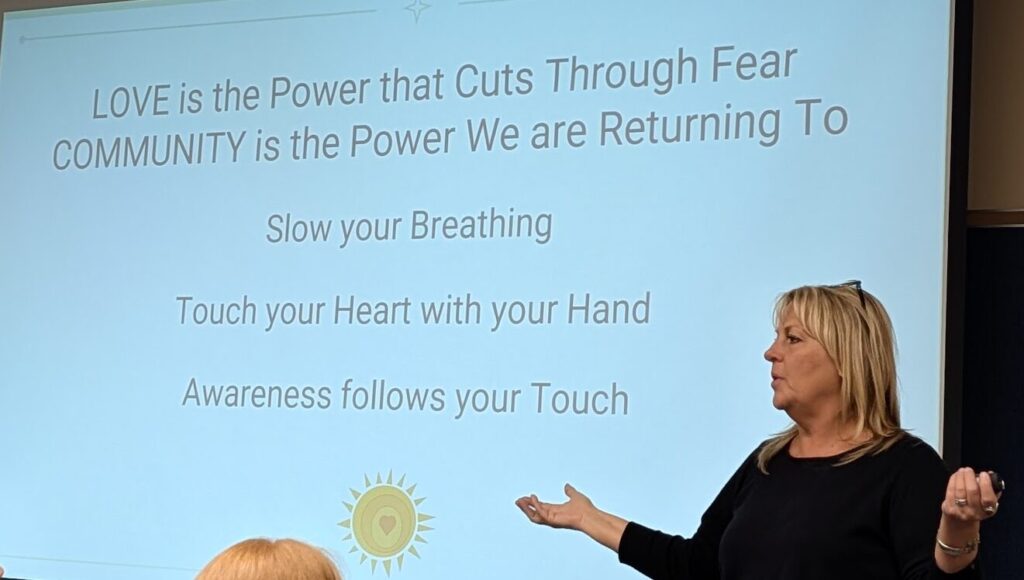
Lisa Cobb
Love as a practice
Near the end, Cobb guided the room through a visualization that began with one person or pet who brings a sense of love and safety. Then the focus widened to immediate family, extended family, neighborhood, county, the state of Michigan, the United States, the continents, and the whole planet, before returning inward again.
It was less about sentiment and more about orientation. If we are going to live through hard things, we have to decide what we are returning to.
She closed by inviting the room to repeat a simple set of wishes, first for themselves and then for others: health, happiness, safety, peace, and joy. In a culture that rewards self criticism and reactive outrage, that kind of practice can feel quietly brave.
What this signals for White Lake
Common Ground Community is responding to something real. People are overwhelmed, and many do not have a safe place to say so. We are absorbing more information than our bodies were built to carry. Division does not only live online. It shows up in homes, friendships, and how safe people feel in public spaces.
In that context, a gathering about anxiety and resilience becomes more than a nice program. It becomes community support in action, the kind that helps people stay steady enough to keep showing up.
That may be the real stakes. If we do not learn how to regulate ourselves, we will keep handing our lives, and our relationships, over to the loudest fear of the day.
What is next
Common Ground Community shared a few ways to stay connected, including a sign up sheet for future updates and an invitation to suggest topics the community wants help understanding.
Their next event is a forum on artificial intelligence and how it works, scheduled for April 14, also held at the White Lake Community Library.
If you have been feeling the weight of the world lately, the March 3 gathering offered one clear message: you are not alone, and you are not broken. You are human in a hard season.
The question now is not whether uncertainty will continue.
The question is what practices we will build, individually and together, so we do not lose ourselves inside it.
To get in touch with Lisa Cobb or learn more about her services, visit her website.
Learn more about local poet, Julie Essenberg here.
Stay connected to what’s happening in our area by visiting CatchMark Community.
Powered by CatchMark Technologies — helping people, solving problems. Explore more on our website.