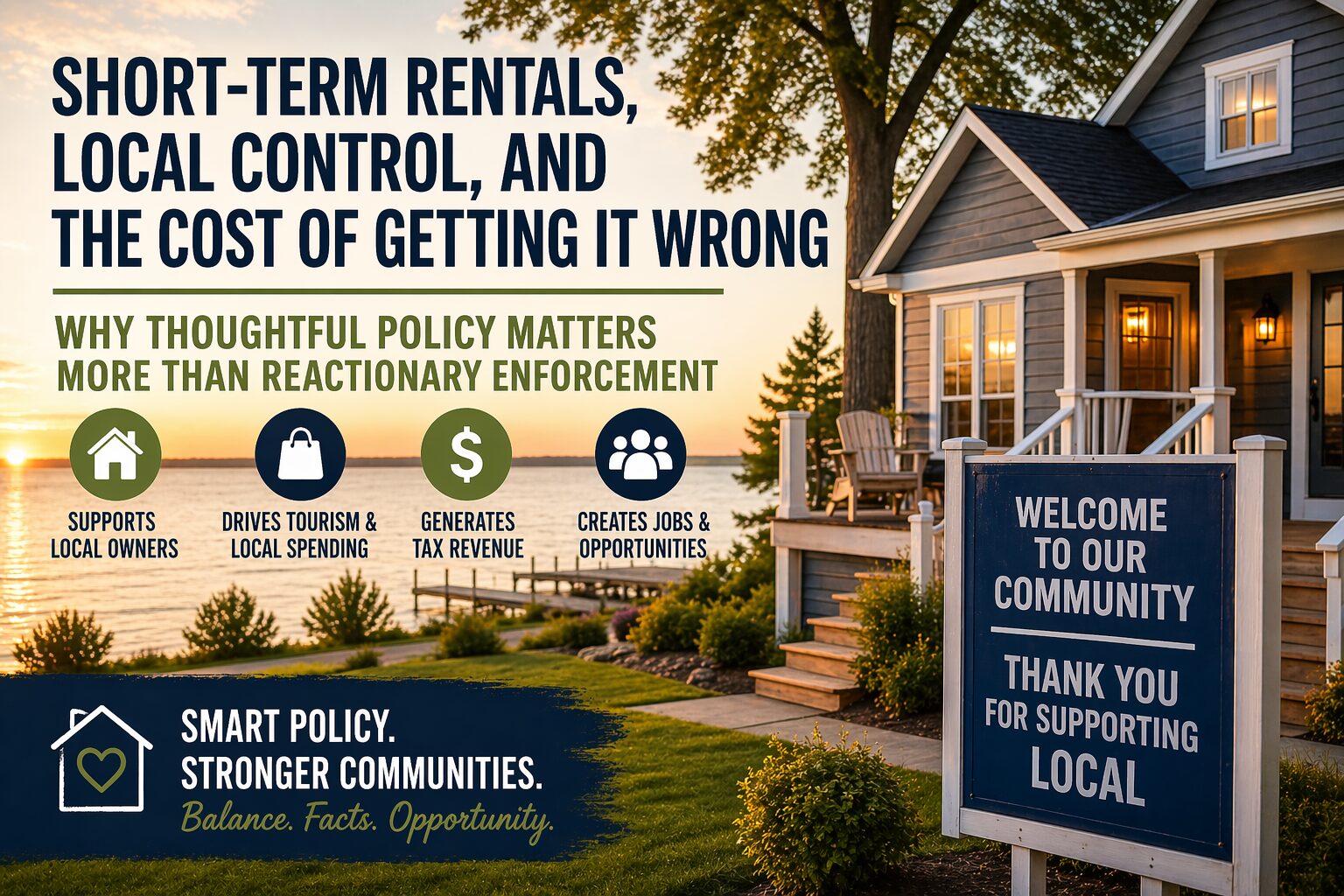
Across the country, and increasingly here in West Michigan, short-term rentals have become a focal point of local policy debates. Muskegon County’s reported investment in technology to identify and track these properties is just the latest example of a broader trend. Local governments are stepping in with new rules, new enforcement mechanisms, and, in some cases, a growing sense of urgency to “rein in” the market.
The intent behind these actions is often understandable. Leaders are responding to concerns from residents about housing availability, neighborhood character, and fairness. But good intent does not guarantee good policy. And in the case of short-term rentals, much of the current approach is being shaped by incomplete information, outdated assumptions, and, at times, a misunderstanding of how these properties actually function within a community.
If we are not careful, we risk solving the wrong problem in the wrong way.
Short-Term Rentals Are Not a New Problem to Be Fixed
Short-term rentals are often framed as a disruptive force that suddenly appeared and needs to be controlled. In reality, they are simply a modern evolution of something that has always existed.
Vacation homes. Seasonal rentals. Lake cottages passed down through families. These have long been part of the economic and cultural fabric of communities like Muskegon County. Platforms have made them more visible and more accessible, but the underlying concept is not new.
What has changed is scale and transparency. And that visibility has led to increased scrutiny.
The question is not whether short-term rentals should exist. They already do. The real question is how they should be integrated into the broader local economy in a way that balances opportunity with responsibility.
The Economic Impact Is Often Underestimated
One of the more persistent misconceptions is that short-term rentals primarily benefit out-of-town owners at the expense of the local community. While that can happen in certain cases, it is far from the dominant reality in markets like ours.

Many short-term rentals are owned by local or regional residents. They represent second homes, retirement investments, or properties that help offset costs through seasonal use. The income generated often stays local.
Beyond ownership, the economic ripple effect is significant.
Guests who stay in short-term rentals do not exist in isolation. They eat at local restaurants, shop at local stores, attend local events, and contribute to the broader tourism economy. In many cases, they bring business into areas that do not have the hotel infrastructure to support traditional lodging demand.
Additionally, short-term rentals contribute through accommodation taxes and local fees. These revenues support infrastructure, tourism promotion, and community services. Eliminating or over-restricting these properties does not eliminate demand. It simply redirects it, often outside the community.
Housing Concerns Deserve Attention, But Precision Matters
The most common argument against short-term rentals centers on housing availability. The concern is that converting long-term housing into short-term rentals reduces supply and drives up prices.
In some high-density urban markets, there is evidence to support this concern. But applying that same conclusion broadly, without regard to local context, leads to flawed policy.
Muskegon County is not New York City. It is not San Francisco. It has different housing dynamics, different population patterns, and a significant seasonal component to its economy.
Many properties used as short-term rentals would not realistically return to the long-term housing market if restricted. Some are seasonal homes not suitable for year-round living. Others are owned specifically for part-time use. In these cases, restricting short-term rentals does not meaningfully increase housing supply. It simply reduces property utilization and local economic activity.
That does not mean housing concerns should be ignored. It means they should be addressed with targeted, data-driven solutions rather than broad assumptions.
Enforcement Technology Raises Important Questions
The push toward enforcement, including reported investments in intelligence platforms, is not happening in a vacuum. One of the primary drivers behind these efforts is accommodation tax collection.
On the surface, that goal makes sense. Local governments want to ensure they are capturing appropriate tax revenue from short-term rentals, similar to hotels and other lodging providers. But the execution, and in some cases the underlying assumptions, deserve closer scrutiny.
Major platforms like Airbnb and VRBO already have systems in place to collect and remit accommodation taxes in many jurisdictions. In these cases, taxes are built directly into the booking process and paid by the guest at the time of reservation. The platform then handles remittance to the appropriate tax authorities.
This creates an important question. If taxes are already being collected at the platform level, what problem is additional enforcement technology actually solving?
In some cases, local policies layer additional registration requirements, fees, or taxes on top of what is already being collected through the platforms. The result is not better compliance. It is duplication.
Property owners can find themselves paying local fees and taxes, while guests are simultaneously paying accommodation taxes through the platform. In effect, the same activity is being taxed from multiple angles. And unlike broader tax structures, this burden is concentrated on a very specific group of people, property owners and their renters.
That approach raises fairness concerns, but it also introduces practical risk.
When compliance becomes overly complex or financially burdensome, behavior changes. Some operators will choose to exit the market. Others will look for ways to operate outside of it.
This is where the concept of “underground” rentals becomes very real.
If enforcement is perceived as aggressive, and the regulatory structure is viewed as excessive or redundant, some property owners will simply bypass the major platforms altogether. Direct bookings, informal networks, and off-platform arrangements are not difficult to establish. When that happens, visibility decreases, compliance drops, and tax collection becomes harder, not easier.
In other words, the very tools designed to increase oversight can unintentionally reduce it.
There is also a broader governance question at play. Investing in surveillance-style technology to monitor property usage suggests a level of enforcement intensity that may not align with the actual scale of the issue. It shifts focus toward tracking and policing, rather than simplifying and improving the system itself.
A more effective approach would prioritize alignment with existing platform-based tax collection, reduce redundancy, and make compliance straightforward for property owners. If the goal is to collect appropriate revenue, the most efficient path is to work with the systems already in place, not build parallel ones that increase cost and complexity.
At its core, this is a question of strategy.
Do we create a system that encourages participation and compliance, or one that pushes activity into the shadows?
The answer will determine not only how effective enforcement is, but how sustainable it becomes over time.
The Risk of Overcorrection
One of the most consistent patterns in public policy is overcorrection. A legitimate concern emerges, pressure builds, and the response swings too far in the opposite direction.

Overly restrictive policies can:
Reduce tourism revenue
Limit property rights for homeowners
Shift demand to neighboring communities
Create underground or non-compliant markets
Discourage investment in local properties
Once these impacts take hold, they are difficult to reverse. The goal should not be to eliminate short-term rentals. It should be to manage them effectively.
A Better Path Forward
This is not an argument for no regulation. It is an argument for better regulation. A thoughtful approach would focus on:
Clear and reasonable standards for operation
Fair taxation that aligns with other lodging options
Enforcement that prioritizes actual issues, not blanket monitoring
Community input grounded in accurate information
Ongoing evaluation based on local data, not national headlines
Most importantly, it requires a shift in mindset. Short-term rentals should not be viewed as a problem to eliminate, but as a component of the local economy to be managed responsibly.
Getting the Conversation Right
At the heart of this issue is something larger than short-term rentals. It is about how communities make decisions.
When complex issues are reduced to simple narratives, the outcomes suffer. When policy is driven by perception instead of data, unintended consequences follow.
Short-term rentals are not inherently harmful or inherently beneficial. They are a tool. Like any tool, their impact depends on how they are used and how they are governed.
If we want strong communities, we need to move beyond reactionary decisions and toward thoughtful ones. That starts with a more accurate understanding of the issue, a willingness to challenge assumptions, and a commitment to getting the balance right.
Follow along on social media for daily updates, community highlights, and moments that happen between the headlines.
Facebook • Instagram • YouTube • TikTok • LinkedIn • X
Stay connected to what’s happening in our area by visiting CatchMark Community.
Powered by CatchMark Technologies — helping people, solving problems. Explore more on our website.