
Michigan has a school district problem.
Not because local schools do not matter. They do. Not because community identity is unimportant. It is. And not because every small district is failing. Many small districts are deeply loved, well led, and central to the life of their communities.
The problem is that Michigan has built one of the most fragmented public education systems in the country, and fragmentation is expensive.
According to federal data for the 2023-24 school year, Michigan had 882 operating public school districts serving about 1.43 million students. That works out to roughly 1,600 students per district.
Compare that with Florida, which had 82 districts serving about 2.87 million students. Maryland had 25 districts serving about 890,000 students. Hawaii operates as one statewide school district. North Carolina, with slightly more students than Michigan, had 357 districts.
Michigan’s structure is not inevitable. It is a choice, shaped by history, geography, local control, and politics. The question is whether it still makes sense.
Increasingly, the answer is no.
A SCHOOL DISTRICT SYSTEM BUILT FOR A DIFFERENT ERA
Michigan’s school district map grew out of a time when communities were smaller, transportation was harder, and schools were built around local townships, villages, and neighborhoods. Local control made sense because education was delivered locally, funded locally, and administered locally.
Over time, many states moved toward county-based or regional school systems. Michigan largely did not.
Instead, Michigan kept a large number of independent local districts, layered with intermediate school districts, charter schools, schools of choice, and state and federal requirements. The result is a system with many separate administrations, many separate boards, many separate contracts, many separate software systems, many separate transportation plans, and many separate facilities decisions.
THE COST SCHOOL DISTRICT DUPLICATION
That structure comes with a cost.
Every district, whether it serves 500 students or 15,000 students, needs some version of a superintendent, business office, payroll system, human resources function, curriculum coordination, technology administration, compliance reporting, special education administration, transportation planning, food service management, facilities oversight, and board governance.
Some of those functions do not shrink neatly just because enrollment is small. A district with 700 students still has to file reports, manage audits, handle state compliance, negotiate contracts, insure buildings, maintain buses, and support technology. When those fixed costs are spread across fewer students, the cost per student rises.
That is the basic efficiency argument for consolidation.
HOW MICHIGAN COMPARES TO OTHER STATES
Michigan’s 882 districts stand out when compared to states that organize education differently.
Florida is mostly county-based. It has more than twice Michigan’s student enrollment but fewer than one-tenth the number of districts. Maryland also uses a county-based model, with only 25 districts. Hawaii has one statewide district. North Carolina has a more mixed model, but still operates far fewer districts than Michigan relative to student population.
These models are not perfect. Larger districts can become bureaucratic. A statewide or countywide system can feel distant from parents and local communities. Consolidation can create longer bus rides, political fights, and fears that small towns will lose their school identity.
But the comparison proves an important point: Michigan’s number of districts is not required to educate children well. Other states educate far more students with far fewer administrative units.
A simple comparison shows the difference:
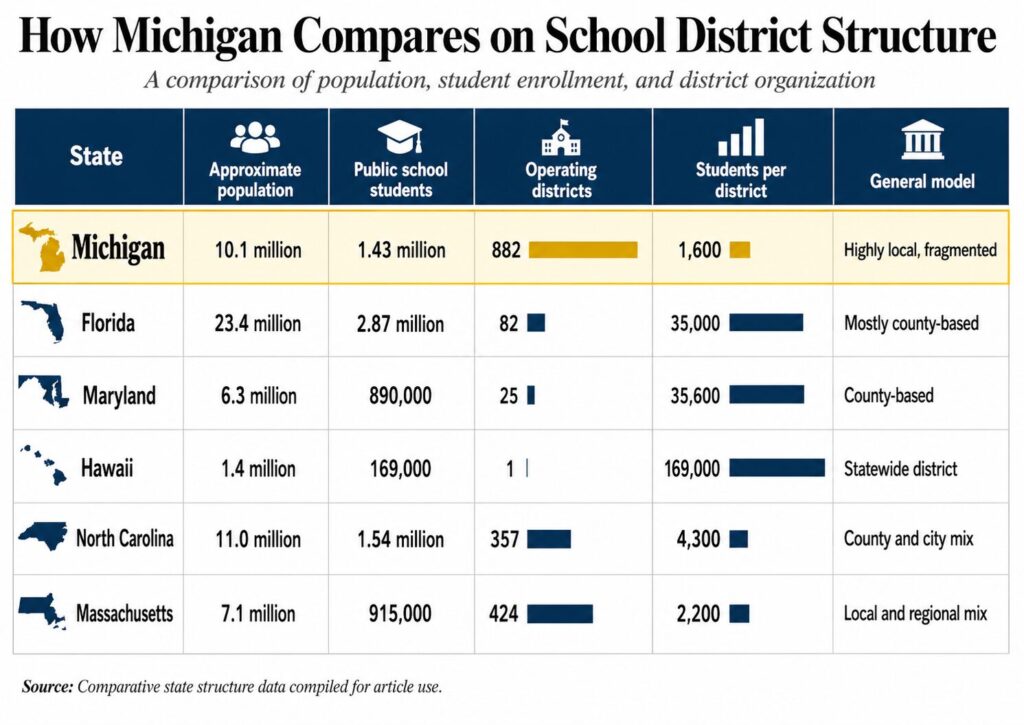
The most important lesson is not that Michigan should copy one state exactly. It is that Michigan has room to rethink its structure.
SPENDING NEAR AVERAGE, RESULTS BELOW AVERAGE
The strongest argument for Michigan’s current system would be this: yes, we have many districts, but the system produces better results.
Unfortunately, the data does not support that argument.
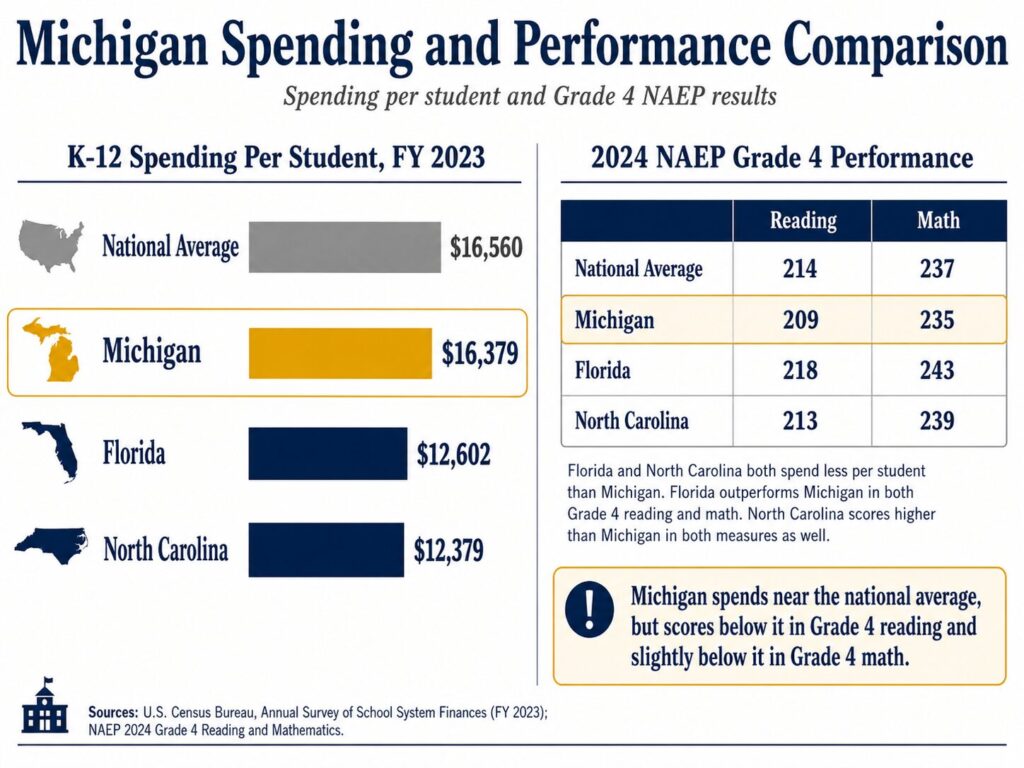
In fiscal year 2023, Michigan spent $16,379 per student in current K-12 expenditures, which was close to the national average of $16,560.
That was more than Florida at $12,602 per student and North Carolina at $12,379 per student. It was less than Maryland at $19,349, Hawaii at $20,056, and Massachusetts at $24,850.
Spending alone does not explain outcomes. But it does raise an important question: if Michigan spends near the national average, and more than some states with stronger results, why are taxpayers not seeing better performance?
WHAT THE TEST SCORES SHOW
The 2024 National Assessment of Educational Progress, often called the Nation’s Report Card, gives us a useful comparison. NAEP is not perfect, and no single test tells the whole story. But it is one of the best tools available for comparing states using a common national measure.
On fourth-grade reading, Michigan scored 209. The national public-school average was 214. Florida scored 218. Maryland scored 216. Hawaii scored 216. North Carolina scored 213. Massachusetts scored 225.
On fourth-grade math, Michigan scored 235. The national public-school average was 237. Florida scored 243. Maryland scored 234. Hawaii scored 239. North Carolina scored 239. Massachusetts scored 246.
Put another way, Michigan spends roughly the national average per student, operates far more districts than many comparison states, and still performs below the national average in fourth-grade reading and slightly below the national average in fourth-grade math.
That should concern taxpayers, parents, educators, and policymakers.
LESSONS FROM FLORIDA, NORTH CAROLINA, AND MASSACHUSETTS
The comparison becomes even more direct when looking at Florida and North Carolina.
Florida spends significantly less per student than Michigan, operates with far fewer districts, and scored higher than Michigan in both fourth-grade reading and fourth-grade math.
North Carolina also spends less per student than Michigan, serves slightly more students, operates far fewer districts, and scored higher than Michigan in fourth-grade math. Its reading score was also higher than Michigan’s, though still below the national average.
Massachusetts shows another side of the issue. It spends far more than Michigan and performs much better. But Massachusetts is not a one-district state. It uses a mix of local and regional districts, which shows that governance structure alone does not determine academic performance. Strong curriculum, high expectations, teacher quality, local culture, state policy, family income, poverty, accountability, and instructional practice all matter.
Maryland and Hawaii complicate the picture as well. Both have far fewer districts than Michigan. Maryland uses a county-based model, while Hawaii operates as a single statewide district. Both spend more per student than Michigan. Their results are mixed. Maryland scored higher than Michigan in fourth-grade reading but slightly lower in fourth-grade math. Hawaii scored higher than Michigan in both fourth-grade reading and fourth-grade math, but its statewide model has not made it a national academic leader.
The honest conclusion is this: consolidation does not automatically improve test scores.
But Michigan’s fragmented structure is expensive, complicated, and does not appear to be producing superior results in return.
If Michigan had 882 districts and ranked near the top nationally in student outcomes, the argument for preserving the current map would be stronger. But Michigan has a large number of districts, roughly average spending, and disappointing academic outcomes, especially in early literacy.
That combination should force a serious conversation.
WHERE CONSOLIDATION CAN SAVE MONEY
Consolidation is most likely to save money when it reduces duplicated administration, combines back-office operations, improves purchasing power, better uses buildings, and spreads fixed costs across more students. The savings are usually strongest among very small districts, especially those with declining enrollment.
Michigan’s own recent governance research found clear economies of scale among very small districts, particularly those under 300 students, and some smaller economies of scale for mid-sized districts. That means there are real savings opportunities in parts of the system.
But consolidation is not magic.
If two districts merge on paper but keep every building open, retain every administrator, preserve every program exactly as it was, and add transition costs on top, savings will be limited. If consolidation becomes merely a new name for the same operating model, taxpayers should not expect much.
The real savings come from hard decisions: fewer duplicated administrative positions, shared services, better facility use, common technology platforms, coordinated transportation, consolidated purchasing, and more strategic staffing.
That is why consolidation should be judged by practical criteria, not slogans.
The goal is not to make districts bigger for the sake of being bigger. The goal is to move more dollars closer to classrooms.
EFFICIENCY IS ALSO AN EDUCATIONAL ISSUE
Consolidation is often discussed as a financial issue, but it is also an educational issue.
Small districts can offer strong relationships, community pride, and personal attention. Those are real strengths. But small scale can also limit what schools are able to provide.
A larger or more regional district may be better positioned to offer advanced coursework, career and technical education, special education supports, mental health services, transportation efficiency, technology support, substitute coverage, curriculum development, extracurricular opportunities, and teacher collaboration.
In many small districts, leaders are forced to make impossible choices. Do they add a reading specialist or keep a building open? Do they invest in cybersecurity or replace a bus? Do they expand career programming or maintain a small central office? Do they protect class sizes or preserve every local tradition?
Consolidation cannot solve every one of those tensions, but it can reduce duplication and create more capacity.
DECLINING ENROLLMENT MAKES THE PROBLEM HARDER
This is especially important in a state like Michigan, where many communities are facing declining enrollment. When a district loses students but still maintains the same buildings, administrative structure, transportation system, and compliance requirements, the financial pressure grows. Eventually, the district has fewer dollars available for instruction, intervention, enrichment, and student support.
In that environment, consolidation should not be viewed only as a cost-cutting tool. It should be viewed as a capacity-building tool.
The goal should be a system where students have access to stronger academic programs, better career pathways, more specialized staff, more stable leadership, and more efficient operations.
STRUCTURE DOES NOT GUARANTEE SUCCESS
It would be too simple to say that fewer districts automatically produce better test scores.
They do not.
Massachusetts performs well with many local and regional districts. Florida performs well with a county-based model. Hawaii has a statewide district but does not lead the country academically. Maryland has a county-based system and mixed results. North Carolina spends less than Michigan and has fewer districts, but it is not a perfect comparison either.
The lesson is not that governance structure alone determines student achievement.
The lesson is that structure affects how efficiently a state can organize improvement.
Michigan has struggled on national academic measures, especially in reading. The state has adopted new early literacy and dyslexia laws, invested in professional learning, and acknowledged that more work is needed. Those reforms matter. But they operate inside a system that is still highly fragmented.
A fragmented system makes statewide improvement harder. It requires hundreds of districts to separately interpret, adopt, fund, staff, implement, and monitor reforms. That slows momentum and creates uneven results.
If Michigan wants better outcomes, it needs both stronger instruction and a more efficient system for delivering it.
LOCAL CONTROL IS VALUABLE, BUT IT HAS A COST
The strongest argument against consolidation is local control.
Communities want a school board they know. Parents want access to decision makers. Towns fear losing their identity if their district merges with a neighbor. In many places, the school is not just an educational institution. It is the center of civic life.
Those concerns should be respected.
But local control is not free. It has a cost in administrative duplication, facility inefficiency, uneven programming, and limited capacity. The question is not whether local control matters. The question is how much taxpayers and students should pay for it.
There are ways to preserve community voice without preserving every separate district structure forever. Local advisory councils, building-level leadership teams, regional boards, protected school identities, shared mascots for certain programs, and phased consolidation models can help communities maintain a voice while reducing unnecessary duplication.
Michigan does not need to erase community identity to build a more efficient education system.
It needs to separate identity from administration.
A PRACTICAL PATH FORWARD
Michigan should not force every district into a single statewide mold. Geography matters. Rural distance matters. Community history matters. Transportation time matters. Student safety matters.
But Michigan should also stop pretending that 882 districts is automatically a virtue.
A serious consolidation strategy could start with several practical steps.
First, require a regular efficiency review for small and declining-enrollment districts. If enrollment falls below certain thresholds, districts should be required to study consolidation, annexation, or shared-service options.
Second, incentivize voluntary mergers with temporary transition funding. Consolidation has upfront costs, including contracts, systems, transportation changes, branding, and facility planning. The state should help pay transition costs when districts produce a credible long-term savings plan.
Third, expand regional shared services through intermediate school districts. Not every district needs to merge immediately, but many can share payroll, transportation coordination, technology, purchasing, curriculum support, cybersecurity, special education administration, and business services.
Fourth, protect classroom dollars. Any savings from consolidation should be transparently reported and directed toward instruction, student support, career programs, literacy, math intervention, and teacher retention.
Fifth, make the data public. Taxpayers should be able to compare administrative cost per pupil, building utilization, enrollment trends, transportation costs, fund balance, academic offerings, and student outcomes across districts.
Sixth, prioritize students over nostalgia. The standard should not be whether adults are comfortable with the current map. The standard should be whether the current map gives students the best education possible with the resources available.
THE BOTTOM LINE
Michigan has too many school districts for the number of students it serves.
That does not mean every small district should disappear. It does not mean every consolidation proposal is wise. It does not mean bigger is always better.
But it does mean the current structure deserves serious scrutiny.
Michigan spends roughly the national average per student, but its academic results are not above average. It operates far more districts than many states, but that local complexity has not translated into stronger statewide outcomes. It carries the cost of fragmentation without clear evidence that students are benefiting from that fragmentation.
At a time when enrollment is declining, costs are rising, student needs are increasing, and academic performance remains a concern, Michigan cannot afford to maintain hundreds of separate systems simply because that is how it has always been done.
The purpose of public education is not to protect district boundaries.
The purpose of public education is to educate children well.
If consolidation can move more money into classrooms, expand student opportunities, reduce duplication, and make the system easier to improve, then Michigan should be willing to have that conversation honestly.
Local pride matters.
But students matter more.
Follow along on social media for daily updates, community highlights, and moments that happen between the headlines.
Facebook • Instagram • YouTube • TikTok • LinkedIn • X
Stay connected to what’s happening in our area by visiting CatchMark Community.
Powered by CatchMark Technologies — helping people, solving problems. Explore more on our website.