WHITEHALL, Mich. — Immigration is one of the country’s most debated issues, but for many people, understanding how the legal immigration system actually works is another matter entirely.
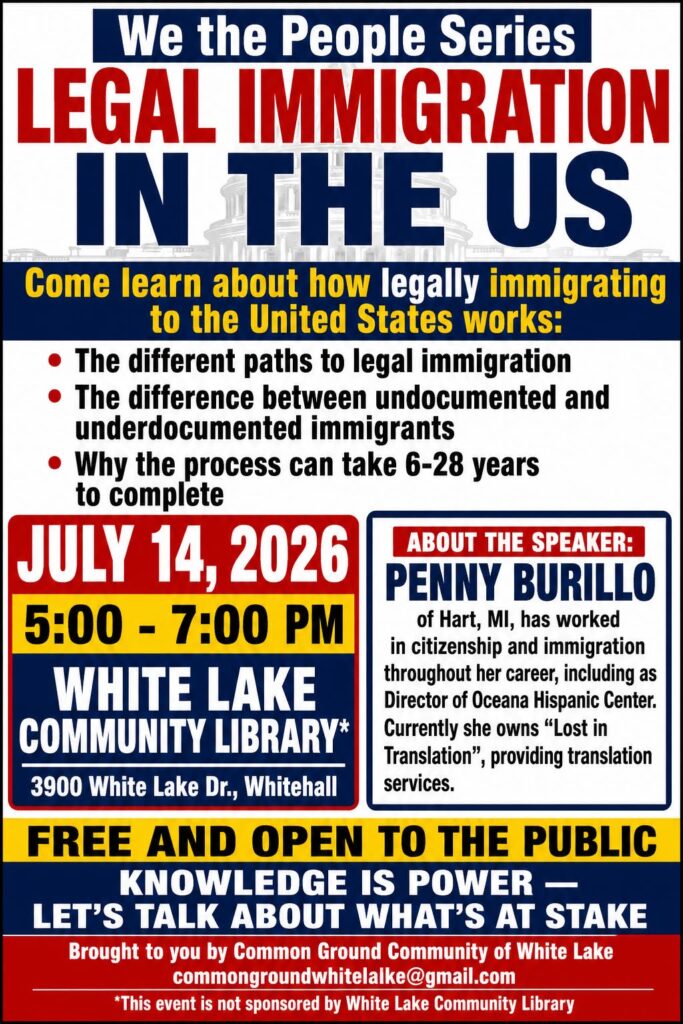
That was the goal Tuesday evening as Common Ground Community of White Lake hosted “Legal Immigration in the U.S.” at the White Lake Community Library, bringing residents together to hear from longtime immigration and citizenship advocate Penny Burillo of Hart. Rather than debating policy, the evening focused on explaining the legal pathways, paperwork, costs, timelines, and challenges involved in becoming a lawful permanent resident or United States citizen.
For a community where agriculture, seasonal workers, local employers, and immigrant families all play a role in the local economy, organizers said understanding the process matters.
“What we want to do is things that are important to our community so we get the real information,” Common Ground Community of White Lake member Sue Mack told attendees as she opened the event.
The forum reflected Common Ground’s broader mission of creating opportunities for residents to hear directly from people with firsthand experience on topics that often generate more opinion than understanding.
Before Burillo spoke, Julie Essenberg read an original poem celebrating America’s history as a nation shaped by generations of immigrants, setting a thoughtful tone for the evening.
More Than “Getting in Line”
Burillo, who has spent decades helping individuals navigate citizenship and immigration, began by addressing one of the most common misconceptions she encounters.
Many people, she said, believe someone can simply fill out an application, get in line, and eventually become a citizen.
“The process is much more complicated than that,” she explained.
She walked attendees through the agencies responsible for immigration, including U.S. Citizenship and Immigration Services and the Department of State, before explaining several terms that are often misunderstood.
Rather than describing someone as “legal” or “illegal,” Burillo said the more accurate terms are lawful and unlawful.
She also distinguished between immigrants, who seek permission to enter and live in the United States, and migrants, who travel from place to place, often for seasonal employment.
Those definitions set the stage for a discussion that showed just how many different immigration pathways exist.
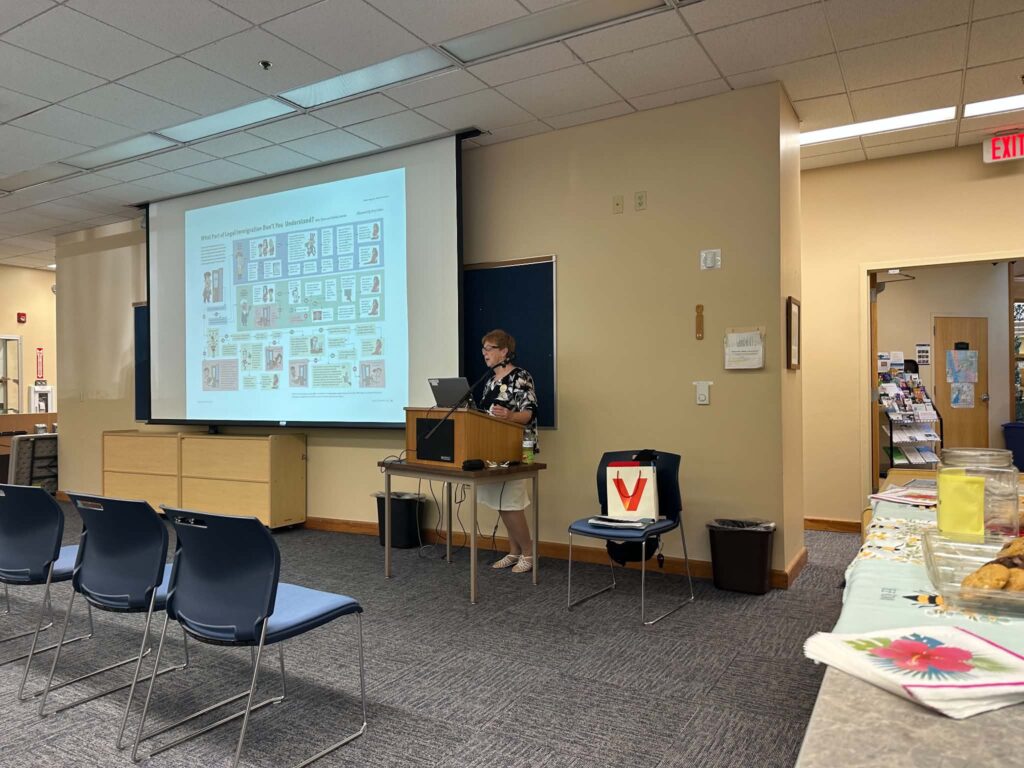
Penny Burillo shares information about the legal immigration process during a July 14 community forum. (Photo courtesy of Julie Essenberg.)
There Is No Single Immigration Process
Burillo explained that people may come to the United States through numerous legal avenues.
Those include sponsorship by a U.S. citizen family member, employment opportunities, humanitarian visas, refugee status, asylum, visas for crime victims or trafficking survivors, student and work visas, and many other specialized programs.
She also explained the difference between a visa, which grants permission to enter the country, and a green card, officially known as a Permanent Resident Card, which authorizes someone to live in the United States.
Many refugees and others also receive an Employment Authorization Document, allowing them to legally work and obtain a Social Security number while their immigration status progresses.
A Process That Requires Time, Money, and Documentation
Throughout the presentation, Burillo emphasized that the legal process often demands far more than paperwork.
Applicants may be required to submit translated birth and marriage certificates, complete physical examinations with designated physicians, provide vaccination records, demonstrate they do not have contagious diseases, and show they are unlikely to become dependent on government assistance.
If a sponsor does not earn enough income, another qualified co sponsor may be required to accept financial responsibility.
Burillo also described the costs involved.
Multiple immigration forms can total thousands of dollars before applicants even reach interviews or medical examinations, with additional fees often required later for renewals or citizenship applications.
For many families, those expenses come on top of travel costs for appointments in Grand Rapids or the Detroit area.
Citizenship Brings Another Set of Challenges
Even after receiving a green card, becoming a U.S. citizen requires another lengthy process.
Burillo explained that most permanent residents must wait five years before applying for naturalization, while spouses of U.S. citizens may apply after three years if other requirements are met.
Applicants must demonstrate good moral character, meet residency requirements, and pass both an English language and civics examination.
Audience members also asked about the English language testing required for citizenship, including whether the government provides help with pronunciation.
Burillo said applicants can attend citizenship classes to prepare for the exam, but she has never seen the government provide specific pronunciation instruction. Instead, she said success comes through practice and repetition. She acknowledged that the interview itself can be nerve racking, and nervousness or a heavy accent can make communication more difficult, sometimes requiring applicants to return for a second interview.
That fear, she said, is one reason some lawful permanent residents simply continue renewing their green cards every 10 years instead of seeking citizenship.
Local Questions Reflected Local Concerns
As the evening shifted into questions, many focused on situations that resonate in West Michigan.
Residents asked about migrant farm workers seen throughout communities such as Hart, Shelby, and Oceana County.
Burillo explained that many agricultural workers legally enter the United States through the federal H2A visa program, which allows employers to recruit temporary agricultural workers when domestic labor is unavailable.
She also discussed how rising labor costs, transportation requirements, housing obligations, and other regulations have made that program increasingly expensive for some farmers.
Other questions explored family sponsored immigration, adoption, fiancé visas, refugee and asylum cases, Temporary Protected Status, deportation procedures, and the lengthy waits many applicants experience before decisions are made.
When asked whether people sometimes abandon the immigration process after years of waiting, Burillo said some do.
She said she has known families who returned to their home countries because they feared current circumstances in the United States or simply became overwhelmed by the process.
Challenging Common Assumptions
Several audience questions centered on taxes and public perceptions surrounding immigration.
Burillo challenged one frequently repeated claim that undocumented immigrants do not pay taxes.
She explained that many people use an Individual Taxpayer Identification Number, or ITIN, to file federal income taxes even if they are not eligible for Social Security numbers or many federal benefits.
She also shared personal examples from her decades assisting families, including one involving her own daughter in law’s fiancé visa process.
That experience illustrated how immigration officers may conduct separate interviews and ask detailed personal questions to verify that marriages are legitimate before approving permanent residency.
Understanding Before Debating
The evening did not seek consensus on immigration policy.
Instead, it reflected Common Ground Community of White Lake’s goal of giving residents factual information from someone who has worked directly within the immigration system for decades.
For White Lake area residents, many of whom encounter seasonal agricultural workers, immigrant owned businesses, multilingual neighbors, or broader national conversations about immigration, the forum offered context that is rarely captured in headlines or political debate.
Whether attendees left with changed opinions or simply a better understanding of the process, the central message remained consistent.
Understanding how legal immigration works begins with learning what the system actually requires before forming conclusions about it.
Follow Common Ground Community of White Lake
Follow along on social media for daily updates, community highlights, and moments that happen between the headlines.
Facebook • Instagram • YouTube • TikTok • LinkedIn • X
Stay connected to what’s happening in our area by visiting CatchMark Community.
Powered by CatchMark Technologies — helping people, solving problems. Explore more on our website.