Before any proposal is ever brought forward, before any vote is taken, and before any headlines are written, a quieter step is happening across the White Lake area. Residents and local leaders are trying to understand what data centers are and what they could mean here.
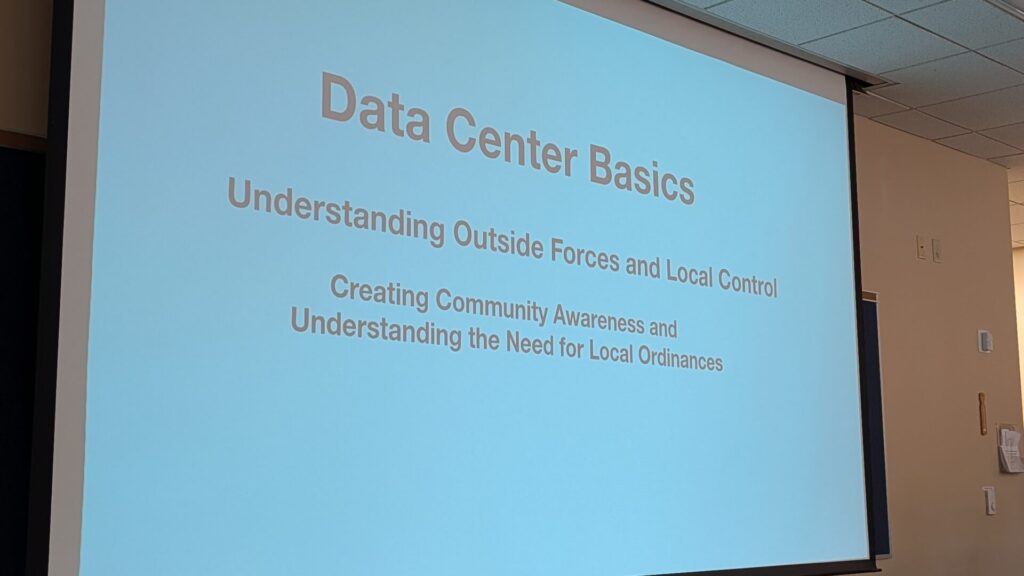
That was the focus of a recent presentation held March 24 at the White Lake Community Library, led by Marisa McGlue, a member of the White River Township Planning Commission, with research and development support from Connie Crancer. The goal was not to persuade, but to prepare.
“We wanted to create a presentation for community awareness,” McGlue said. “To understand the need for local ordinances and what we can actually control.”
The room reflected that intent. Community members came curious, asking questions throughout. Students from Montague High School attended and were actively engaged in the discussion, signaling that this is not just a planning issue for today, but one that will shape the future they inherit.
Why this conversation is happening now
Eight months ago, McGlue said she had barely used the term “data center.” Now, it is a topic communities across Michigan are being asked to consider.
The reason is not just technology, but timing.
Artificial intelligence is driving demand for what are called hyperscale data centers. These are far larger and more complex than traditional facilities, requiring significant power, cooling systems, and infrastructure. At the same time, both federal and state efforts are encouraging their development through policy and tax incentives.
That combination has created a sense of urgency.
“This change is happening,” McGlue said. “Some of it is malleable and some of it is not.”
Which leads to the real question facing local communities.
If this is coming, how do we respond?
What people came to understand
The presentation walked through the basics. A data center is essentially a facility that stores and processes digital information, from emails and photos to financial transactions and AI systems. They can be small, but the ones driving today’s conversation are anything but.
With size comes impact.
Attendees heard about the scale of energy required to power these facilities, the water sometimes needed for cooling, and the infrastructure that supports them. They also heard something more nuanced.
There is no simple answer.
Electric rates could rise or stabilize depending on how systems are built. Water use varies depending on technology. Jobs may come, but many are temporary or indirect. Property tax benefits exist, but they fluctuate.
The takeaway was not certainty. It was complexity.
And that complexity is exactly why this conversation is happening at the local level.
What communities can actually control
One of the clearest messages of the night was this. Communities cannot simply say no.
Under Michigan law, municipalities must allow for lawful land uses, including industrial development.
That reality shifts the conversation.
Instead of asking whether data centers should exist, communities are being pushed to ask different questions.
Where would they go
What conditions would be required
What protections would be in place
That is where zoning, ordinances, and master plans come in.
“These are the things we can control,” McGlue said.
From noise and lighting to water use, setbacks, and long term site restoration, local governments have tools. But those tools only work if they are in place before a proposal arrives.
Examples from other communities were discussed, including areas that found themselves reacting after the fact without clear guidelines.
That is the situation local leaders are trying to avoid.
A room full of questions, not conclusions
If there was a defining tone of the evening, it was not agreement. It was engagement.
Some attendees expressed concern about environmental impacts and the pace of AI development. Others saw opportunity in economic growth and technological advancement. Many were somewhere in between.
One attendee summed up the tension.
“It’s impressive,” they said. “But do we want it in our backyard?”
That question did not get a definitive answer. It was not supposed to.
Instead, the conversation shifted toward what it would look like to shape outcomes rather than react to them.
Ideas ranged from requiring developers to invest in local infrastructure or training programs, to pairing data centers with industries that could reuse excess heat, to ensuring emergency services are equipped to respond to new types of facilities.
The common thread was this.
If something comes, the community should be ready to define the terms.
What this signals moving forward
This presentation was not about a specific project. No data center has been formally proposed for the White Lake area.
That is exactly the point.
“This is about being proactive,” McGlue said.
Across the region, some municipalities are already working on ordinances. Others are just beginning the conversation. The goal of this presentation was to help close that gap and give residents a baseline understanding before decisions are in front of them.
Because when those decisions come, they will come quickly.
And the communities that are most prepared will not be the ones that knew everything.
They will be the ones that asked questions early.
If your organization or community group is interested in hosting a similar presentation, you can reach out to the White Lake Area Climate Action Council or connect directly with Marisa McGlue at marisamcglue@gmail.com to bring the discussion to your group.
As the evening made clear, this is not just about data centers.
It is about whether communities are ready to shape what comes next.
Stay connected to what’s happening in our area by visiting CatchMark Community.
Powered by CatchMark Technologies — helping people, solving problems. Explore more on our website.