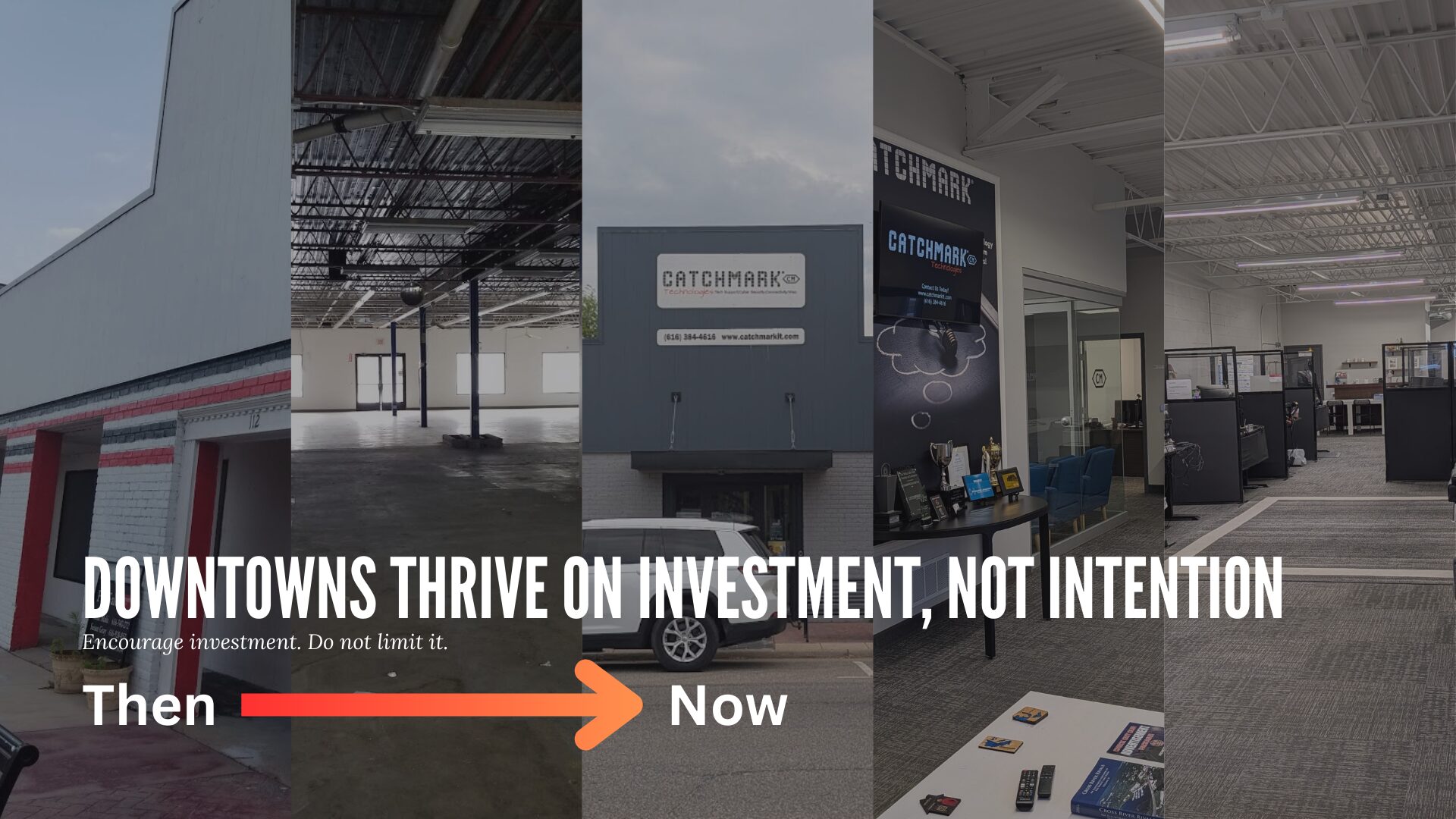
In 2019, we purchased 112 E. Colby St., a 7,000 square foot building in downtown Whitehall, for and initial investment of $160,000.
Despite its prime location and proximity to the social district, the building had remained vacant for several years. Originally designed as a restaurant and bowling alley, its specialized layout failed to attract the investors needed to complete the project. Despite its size, dual access points, and competitive price per square foot, it also failed to attract any retail business willing to invest.
CatchMark could have located anywhere. Our customers are regional, and much of our work is remote based. Instead, we chose to take a risk on Whitehall because we saw both a need and a potential win win scenario.
We invested another $180,000 into renovations, using local contractors and vendors. We cleaned it up. We modernized it. We transformed it into something we could be proud of.
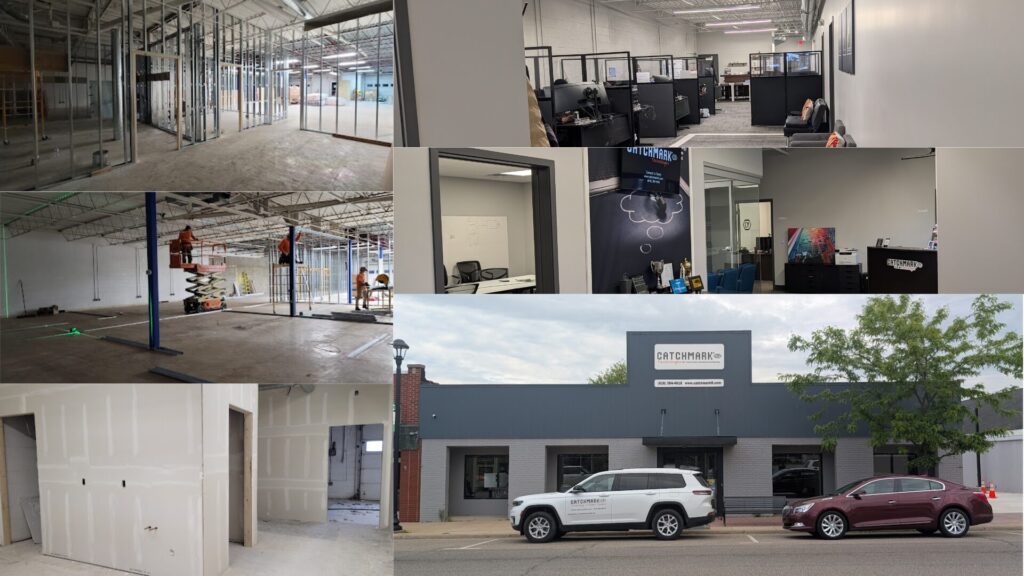
Then we moved our company here.
Today, we bring 15 employees into downtown Whitehall every single day (four of whom live and own property here). We also bring clients and customers from all over the state year round. Those employees, clients, and visitors:
• Eat at local restaurants
• Have drinks after work
• Shop locally
• Participate in community events
• Experience our downtown firsthand
That is real economic activity. Not theoretical. Not aspirational. Real. Beyond simply occupying space, we have contributed to the community fabric.
• We provide free WiFi that supports the social district.
• We donated wall space and funding for the pocket park mural.
• We financially support local organizations.
• We invest time and money into parade livestreams and community involvement.
We did not just move in. We committed.
A Troubling Discussion
Recently, during a city council discussion about zoning and downtown use, City Manager Dan Tavernier said, “I think the worst thing to have in any downtown is a vacant lot or a vacant building.” I agree completely.
That same discussion acknowledged that “some of the spaces are only allowed to have retail,” and that limitation may be contributing to the challenge.
A council member candidly stated, “We all know what a good downtown looks like… but that ain’t it.” They went on to describe a Friday evening where “you can throw a stone down and not hit a person. Something’s wrong.” Ironically, the concern about vibrancy was directed at the very types of businesses that have been investing and bringing people downtown.
These comments reflect a shared concern, but a misguided approach. We all want a thriving downtown. The real question is how to get there.
I understand the vision of a downtown filled with boutiques, gift shops, and specialty retail. It is an attractive picture. Retail has “always been the idea to draw people in there,” as one council member said.
Good Intentions Do Not Make Good Policy
Retail is not currently clamoring to move into many of our available spaces. That is not primarily a zoning issue. It is a market reality shaped by online commerce and shifting consumer behavior and there are empty buildings to reinforce it.
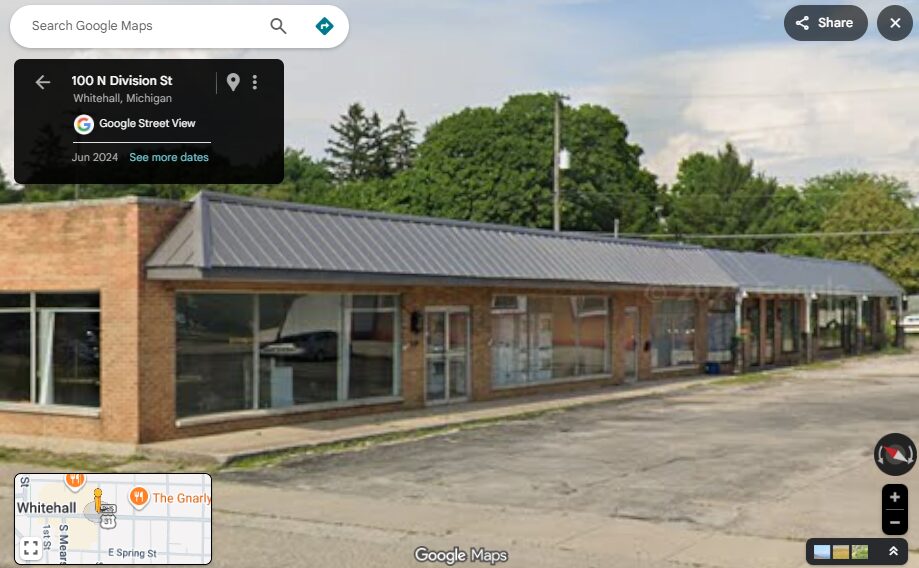
One council member described the dilemma as “a bit of a chicken and an egg.” That is exactly right. Without consistent demand, small retail operators struggle. When retail struggles, fewer entrepreneurs are willing to take the risk.
So how do you bring more people downtown?
You encourage businesses to set down roots where they can sustainably operate. You create an environment where professionals choose to work and stay, rather than commute elsewhere. Those people bring additional activity, relationships, and investment. Over time, that momentum compounds.
Over zoning for retail does not create retail demand. It creates vacancies, as indicated in this 2025 case study attributing strict zoning laws as a main factor in a growing vacancy crisis. When vacancies are restricted to retail only, you eliminate the possibility of attracting businesses that bring daily population and long term stability.
And again, as was said at the meeting, “the worst thing to have in any downtown is a vacant lot or a vacant building.”
Healthy downtowns are mixed use environments the consist of retail, office, service businesses, and
Residential. They support one another.
During the discussion, someone noted, “Offices attract people and people will spend money at the businesses that are currently open.” That is not theory. That is practical economics.
Offices bring daily population. Residents bring evening and weekend activity. Retail benefits from both.
There was also recognition that successful communities blend uses. “I walk downtown Grand Haven, there’s a mix.” That is true. Thriving downtowns are rarely single use. They are layered and flexible.
If retail downtown generated higher and more stable income than office or service use, I would sell my building tomorrow and move our operations to the industrial park.
That is not rhetoric. That is math.
We are downtown because we believe in it. We are downtown because we are willing to invest in it. But we also operate within economic reality.
One council member said, “It really takes more sustained thought.” I agree. It also takes sustained private investment.
Policy should not attempt to engineer demand that does not exist. It should enable the people willing to invest real capital to do so with confidence.
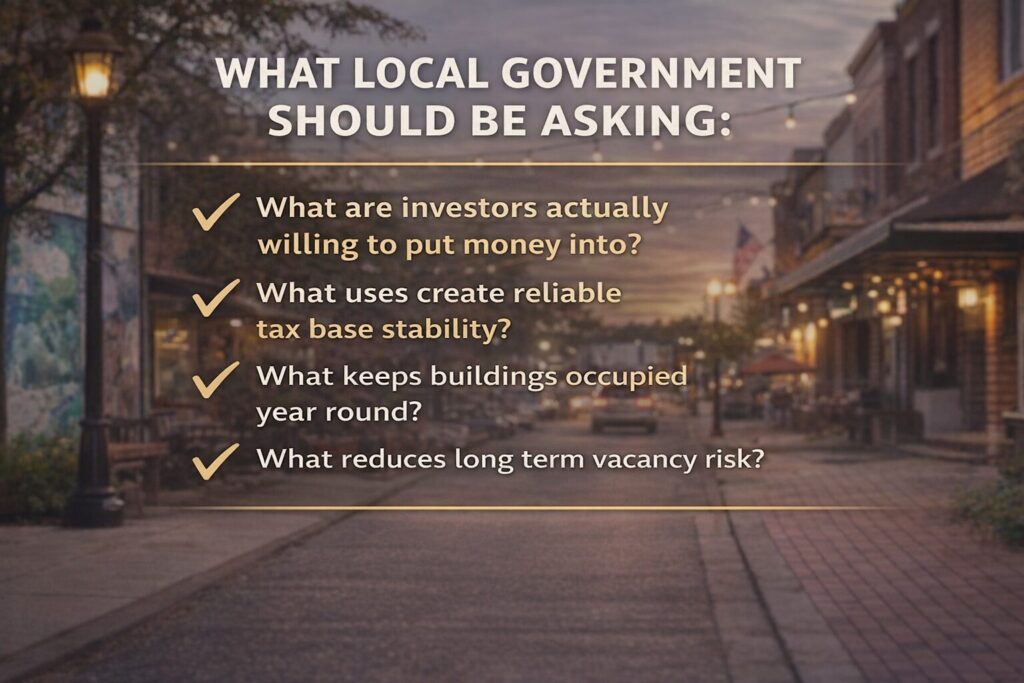
Empty storefronts do not create vibrancy. Occupied buildings do.
If we over zone and limit flexibility: Investors slow down or stop, landlords sit on empty space, buildings deteriorate, the tax base erodes. This is how downtown areas quietly hollow out, and once momentum reverses, recovery becomes difficult and expensive.
We all want the same outcome. A downtown where, as one council member described during Monday night events, there is a “huge draw downtown” and people are buying, gathering, and participating.
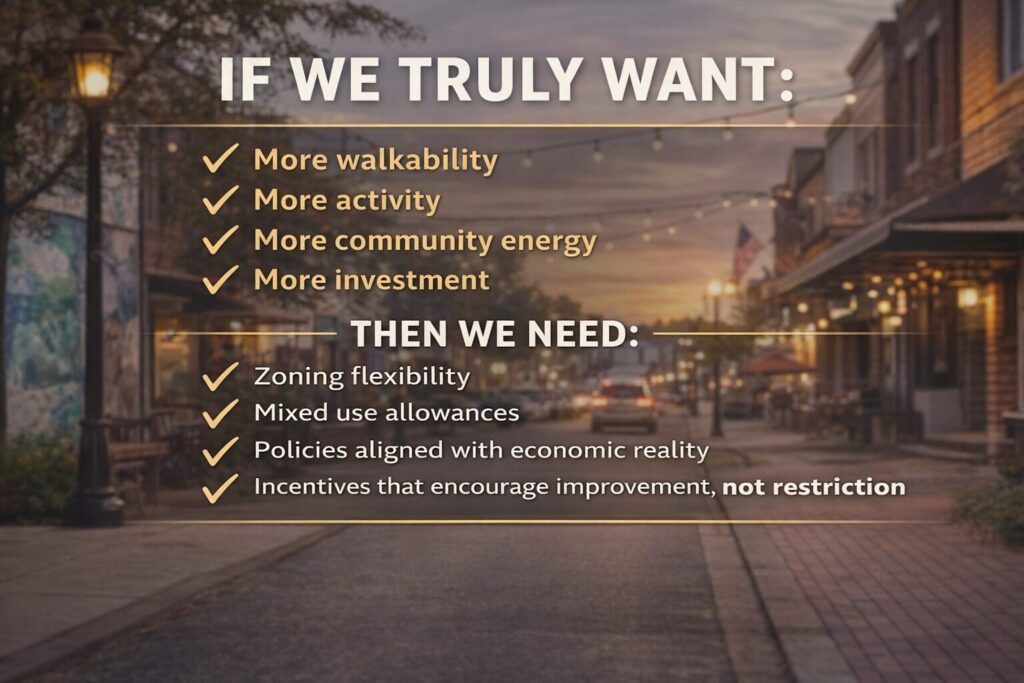
Encourage Investment. Do not limit it
Downtown Whitehall does not need more theory. It needs people willing to bring investment, risk capital, bring employees, attract clients, and commit long term.
The market will ultimately determine what succeeds here. Our policies should make it easier for people to invest in that future, not harder.
At the end of the day, vibrant downtowns are not built by intention alone. They are built by those willing to put real money, real time, and real commitment on the line.
And those people need flexibility to succeed.
Stay connected to what’s happening in our area by visiting CatchMark Community.
Powered by CatchMark Technologies, helping people & solving problems. Explore more on our website.