The White Lake Community Library is working to make the library more comfortable, welcoming, and easier to use for everyone—and they’re asking the community to help guide what comes next.
The library recently received its second “Libraries Transforming Communities” grant through the American Library Association, a program designed to support small and rural libraries that may not otherwise have the resources to make targeted improvements. This year’s grant focuses specifically on accessibility—not just meeting basic requirements, but making sure patrons can truly use the building, services, and programs comfortably.
Why the library pursued this grant
Library staff said they began by looking at local disability statistics, then reflecting on a key question: Who isn’t using the library building—and why? They also realized that many tools and supports that help people with sensory needs (and other accessibility barriers) simply weren’t available on-site.
The overall goal is simple, but meaningful: reduce unnecessary hurdles so people can access library services without barriers—whether that means physical access, sensory comfort, or program experiences that better meet people where they are.
A community conversation—on a snowy day
To start gathering feedback, the library hosted an Accessibility Conversation and invited community members to share ideas and lived experiences. Unfortunately, the event happened on a snowy day when many local closures limited attendance, so the library is continuing to seek input from anyone who couldn’t make it.
Staff emphasized that accessibility decisions shouldn’t be made internally without community direction. The grant dollars are limited, and they want to spend them on what people actually need and will use—not just what others assume might help.
How feedback will shape what’s purchased (and what’s offered)
Community feedback will be used to decide what the grant funds support—especially around sensory-friendly tools and inclusive programming.
Some examples the library is considering include:
- Sensory kits for use inside the library (and possibly to borrow and take home), such as fidgets, calming tools, and headphones
- Sensory-friendly spaces or features, such as a sensory wall or other equipment
- New or expanded programs designed with accessibility in mind—possibly offered at low cost using current staff and partnerships
Staff noted they want to hear what the community actually wants:
Would people benefit from a weekly or monthly sensory story time? A social club or book group for people with developmental disabilities? Sensory kits? Something else entirely? The answer will come from community voices.
What the library already offers (that you may not realize)
The library already has several accessibility features in place, including:
- Large-print books
- ADA door openers
- An accessible website, with ongoing work to meet upcoming public library accessibility standards
- Large-print keyboards on public computers (so popular they expanded them to all public stations)
- Adaptive technology, including an adaptive keyboard and mouse
- Headphones available for patrons to use in the building
The library also shared that they work to make online information accessible by using alt-text and formatting that supports screen readers, with their website serving as the most helpful source for patrons with visual impairments.
What people shared during the discussion
Even with low turnout, the conversation generated a wide range of thoughtful ideas—many focused on the difference between being “up to code” and being truly comfortable.
A few topics that came up:
1) Comfort and navigation inside the building
Someone pointed out that even when aisles meet code, turning radius and “tight corners” can still be difficult for people using mobility aids. Staff also shared that there are specific spots where turning can be challenging, even though the building meets requirements.
2) Restroom access and motion-sensor lighting
Participants talked about how motion-sensor lights can create real problems—especially if lights shut off too quickly or the sensor doesn’t detect smaller movements. They also discussed how restroom doors can be challenging to open from the inside for someone in a wheelchair, even if entry feels manageable.
3) Tools that support independence
People brainstormed practical items that can make a big difference, such as:
- Adjustable-height tables (ideally with an electronic button)
- Touchscreen or alternate computer-access tools
- Page holders, book stands, or page-flipping aids
- Better signage, including Braille labels (and even a Braille label maker)
- Noise-reducing options (like noise-canceling headphones)
4) Sensory supports
The group discussed how overhead lighting, noise, and being approached unexpectedly can create barriers for some patrons. There was interest in options that help people stay comfortable while still using the library.
5) Communication and programming ideas
Participants suggested ideas like:
- A clearer way to announce closing times (for patrons who may not want to be approached or who might miss a quiet reminder)
- Exploring access to ASL (American Sign Language) learning tools for patrons and staff
- Creative ideas like a 3D-printed tactile map of the library layout for patrons with visual impairments
Throughout the conversation, the recurring theme was this: small, practical improvements often help more people than flashy purchases. The “best bang for the buck” may come from removing everyday barriers that patrons encounter repeatedly.
Timeline: the clock is ticking
The library shared that the grant funding must be spent by April, which means decisions and purchases will be happening soon.
They also noted that major building renovations likely won’t be covered by this grant because costs can exceed the grant amount. Those larger projects—such as potential bathroom upgrades, automatic sliding entrance doors, or shelving changes—would be addressed through the library’s Capital Projects fund, supported by the 0.25 millage approved by voters in 2020.
How success will be measured
The library plans to track:
- Attendance at any new programs
- Use of new tools or items purchased with the grant
But they also said success will include something harder to measure—and just as important: community members telling the library they feel more comfortable being there, and more able to participate.
The library still needs your ideas
Because weather kept many people from attending, the library is still actively gathering feedback—especially from:
- People with disabilities
- Caregivers and family members
- Advocates and allies
- Anyone who avoids the library due to barriers (sensory, physical, social, or otherwise)
If you have ideas, suggestions, or even one small detail you’ve noticed that could make the library easier to use, the library wants to hear from you.
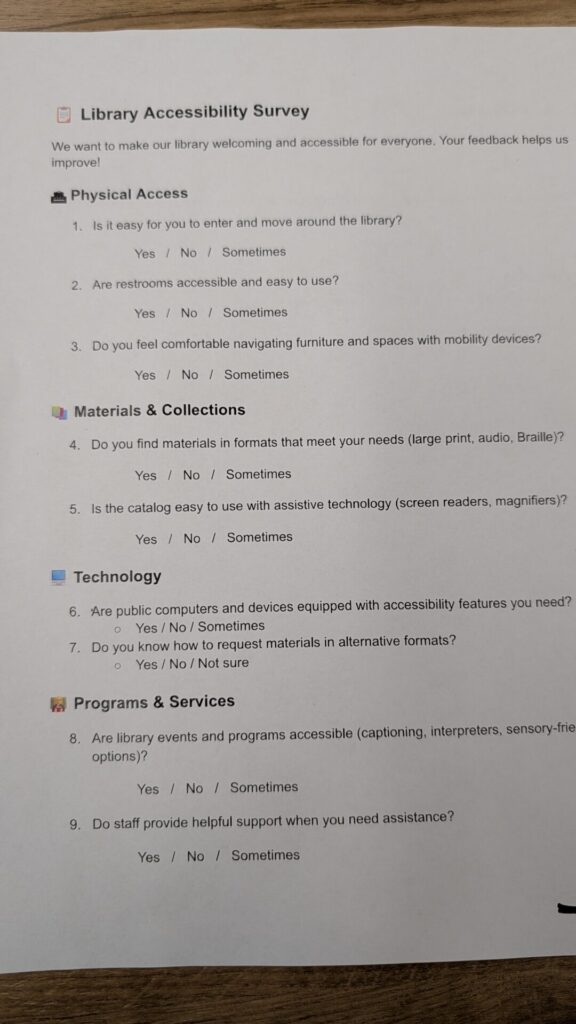

You can reach out anytime:
- Call: 231-894-9531
- Visit: White Lake Community Library, 3900 White Lake Dr., Whitehall, MI 49461
- Online: https://www.wlclib.org/
Accessibility isn’t one-size-fits-all—and the library is treating it as an ongoing effort, not a one-time project. This grant is meant to jump-start improvements, with the intent to sustain and evolve accessibility-focused programs and tools well beyond the grant period.
If you’ve ever thought, “I wish the library had…” or “It would be easier if…,” now is the time to share it.
Stay connected to what’s happening in our area by visiting CatchMark Community.
Powered by CatchMark Technologies — helping people, solving problems. Explore more on our website.