A few weeks ago, I sat in the audience of a city council meeting listening to a debate between our local government officials on an issue that will have long term impact on our community.
The opinions were strong. The tone was confident. Motions were made. Amendments were suggested.
But as the discussion unfolded, something became painfully clear.
Several members of our local government were largely uninformed about the topic they were debating.
Basic facts were missing. Financial implications were vaguely referenced but not clearly understood. Prior case studies from other communities were not cited. Questions that should have been asked weeks earlier were being asked in real time. It was obvious that little actual research had been completed before stepping into that room.
To his credit, the city manager worked hard to ground the conversation in fact and example. He referenced data. He pointed to comparable municipalities. He clarified process and financial realities. He attempted to redirect assumptions back to documented information.
And yet, the discussion still drifted down an uninformed road.
Opinions remained plentiful. Preparation remained thin.
As I sat there, I felt a mix of frustration and recognition. Because if I am honest, I was surprised by this same dynamic when I first began serving on boards and in local governmental roles myself.
I assumed that everyone around the table would treat the role with the weight it deserved. I thought preparation was a given. I believed that service meant study, engagement, and responsibility beyond the public meeting.
What I found instead were leaders who believed the meeting was the job.
They showed up for the monthly gathering. They listened to a summary. They reacted in the moment. They voted. Then they went home.
Some were consistently unprepared. Some failed to communicate with fellow board members between meetings. Some did not read the materials sent in advance. Some did not research comparable communities. And then, when the results were poor or the public backlash came, they were surprised.
Leadership, even at the smallest local level, does not work that way.
When someone commits to serving on a city council, school board, township board, or county commission, they are not signing up for a two hour monthly obligation. They are accepting stewardship over people, policies, and resources that are not their own.
That carries weight.
The responsibilities of local governmental leadership include:
• Reading and understanding all materials before the meeting
• Researching the broader implications of major decisions
• Seeking expert input when needed
• Communicating with fellow board members respectfully and proactively
• Listening to constituents without being ruled by the loudest voice
• Understanding budgets, legal constraints, and long term strategy
• Asking hard questions before, not during, a vote
• Representing the entire community, not just personal preferences
Public service is not a platform for ego. It is not a social club. It is not a title to add to a résumé.
It is fiduciary duty.
Great public servants share common characteristics.
They are curious. They ask, “What do I not know yet?”
They are humble. They are willing to say, “I need more information.”
They are diligent. They prepare before speaking.
They are courageous. They make hard decisions when necessary.
They are steady. They do not swing with every emotional wave.
They are communicative. They build alignment before conflict.
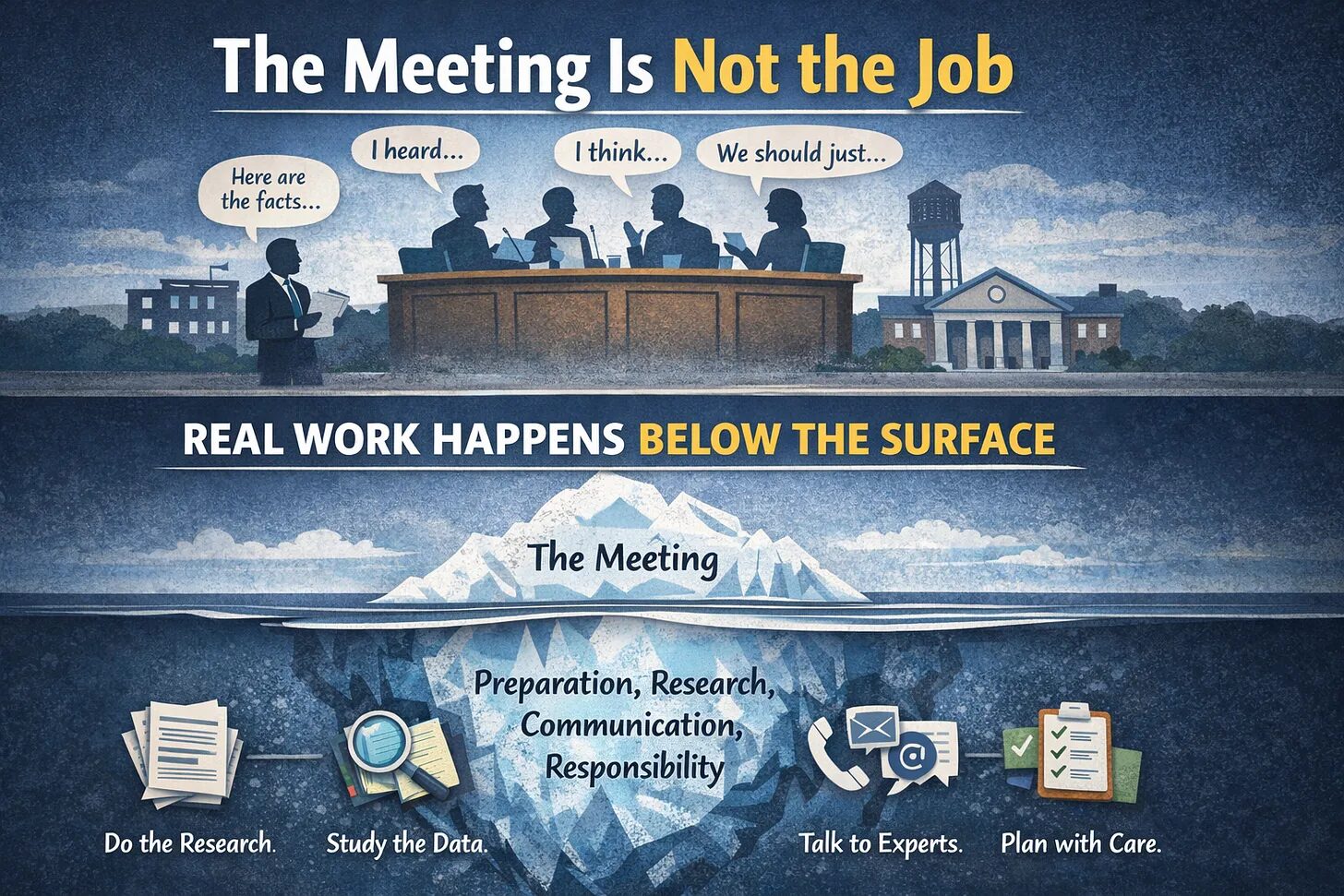
Most importantly, they understand that the meeting is the visible tip of the iceberg. The real work happens in the quiet hours beforehand. Reading. Thinking. Calling experts. Studying data. Wrestling with tradeoffs.
Local government is where decisions hit closest to home. It is where taxes are set, policies are shaped, and culture is formed. The impact is immediate and personal.
That deserves leaders who treat the role with seriousness.
If you are going to raise your hand and ask for the privilege of governing your neighbors, then you owe them more than your opinion.
You owe them your preparation.
You owe them your effort.
You owe them your integrity.
Because in public service, showing up is not enough.
The meeting is not the job.
Stay connected to what’s happening in our area by visiting CatchMark Community.
Powered by CatchMark Technologies, helping people, solving problems. Explore more on our website.