A Local Encounter
During the recent White Lake Chamber–led Labor Day Community Walk, I was approached with a petition to put ranked-choice voting on the Michigan ballot. The moment was a reminder that this debate isn’t just playing out in distant cities, it’s arriving here at home. As residents, we’re being asked to consider whether this system could improve how we elect our leaders. It made me ask a question, which voting method is more democratic?
What Is Ranked-Choice Voting?
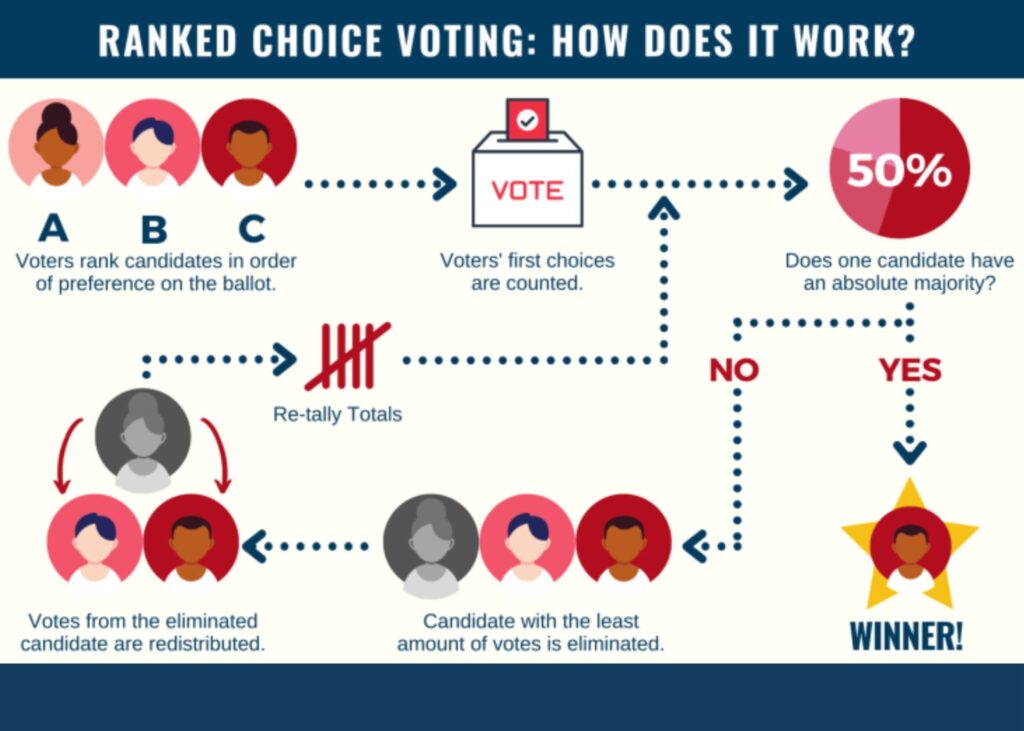
Ranked-Choice Voting (RCV), also known as Instant-Runoff Voting, is a system where voters rank candidates in order of preference, first, second, third, and so on. If no candidate secures a majority (over 50%) of first-choice votes, the candidate with the fewest votes is eliminated. Ballots cast for that candidate are then redistributed to each voter’s next preference. This process continues until a candidate reaches majority support.
The History of Ranked-Choice Voting in Michigan
Michigan’s relationship with ranked choice voting (RCV) has been marked by early experiments, localized adoption, and ongoing statewide debate. Ann Arbor first tested the system in 1974, electing a mayor in 1975 who trailed in first choice votes, only for voters to repeal the system two years later. Ferndale revived interest in 2004, and Eastpointe became the first Michigan city to actually implement RCV in 2019 as part of a federal Voting Rights Act settlement. Since then, Ann Arbor, East Lansing, Kalamazoo, and Royal Oak have all approved RCV measures, though broader rollout has been constrained by state law.
Momentum is now building at the state level. The nonprofit Rank MI Vote is leading a constitutional amendment campaign to put RCV on the November 2026 ballot, drawing on volunteer energy from Michigan’s successful anti gerrymandering effort. The proposal cleared the Board of State Canvassers in mid 2025, allowing signature collection to begin. Yet resistance is strong: polls show a majority of Michigan residents remain skeptical, and in August 2025 the Republican controlled House passed a bill to ban RCV statewide, though it is unlikely to advance in the Democratic led Senate.
In short, Michigan has moved from pioneering trials in the 1970s to a pivotal crossroads today. Whether voters embrace RCV in 2026 or lawmakers succeed in blocking it will determine if the state becomes a national leader or a cautionary tale in the movement for electoral reform.
Our Current System: Plurality
The United States relies on a plurality voting system, often called first past the post. In this method, voters select one candidate for a given office, and the candidate with the most votes wins even if that total falls short of a majority. This system is the standard for nearly all local, state, and federal elections, including congressional and presidential races.
The appeal of this approach lies in its simplicity and efficiency. Results are generally clear, quick, and consistent, reinforcing traditions that have shaped American democracy for centuries. Supporters argue that plurality elections deliver stability and decisiveness, preventing long periods of political uncertainty.
Yet, the system has significant critics. Opponents point out that plurality winners do not always reflect the will of the majority, raising questions about legitimacy and fairness. This concern has fueled interest in reforms such as ranked choice voting or proportional representation, which aim to capture a broader sense of voter preference.
At the heart of the debate is the principle of majority rule. In its purest form, democracy calls for leaders to win more than 50 percent of the vote, a standard often described as the gold measure of legitimacy because it reflects a wider consensus and protects against what some call the tyranny of a mere plurality. By this benchmark, the U.S. system frequently falls short, leaving open the question of whether it fully represents the democratic ideal.
The Case for RCV: Benefits & Backing
- Boosts turnout: Jurisdictions using RCV had an average turnout of 12.8% compared to 10.6% under traditional systems, a 17% relative increase.
- Reduces the “spoiler effect”: Voters can rank a favorite long-shot candidate first without fear of wasting their vote.
- Broadens representation: After San Francisco adopted RCV, representation of people of color increased by eight seats; nationally, women won 45% of multi-candidate RCV races between 2010–2019.
- Encourages civility: In New York City’s mayoral primary, 96% of voters said RCV was easy, and campaigns leaned more toward coalition-building than attacks.
The Critiques of Ranked-Choice Voting: Complexity and Uneven Effects
- Confusion and lower confidence: Some studies found voter confidence and satisfaction decline under RCV, with turnout in certain jurisdictions dropping by about 8%.
- Equity concerns: Research suggests minority voters are more likely to exhaust their ballots and thus lose influence in final rounds.
- Delays and costs: Counting is more complicated and results can take longer to finalize, which has led several states, including Florida and Tennessee, to ban RCV.
- Limited real-world impact: In 2024, only about 30% of RCV races nationwide went beyond the first round, and only three races saw a trailing candidate win after redistribution.
Final Word: Which System Best Serves Democracy?
The most democratic way to elect a public official is by securing a true majority of votes. When this definition is used as the benchmark, both plurality and ranked choice voting fall short. Plurality can result in a candidate winning without majority support, while ranked choice can produce winners who did not lead in first-choice votes. In those cases, second-place rankings are elevated to the same weight as first-place preferences, blurring the line between strong support and compromise.
My Take: if the goal is to strengthen democracy and we are prepared to invest the time and effort to change election laws, we should aim for the clearest standard of legitimacy. Ranked choice voting may improve upon plurality in certain ways, but it does not go far enough. A true commitment to democratic outcomes means adopting majority elections, using runoffs when necessary, rather than settling for systems that only approximate majority rule.
If you like this article you may enjoy other opinion pieces from CatchMark Community. Find them HERE.