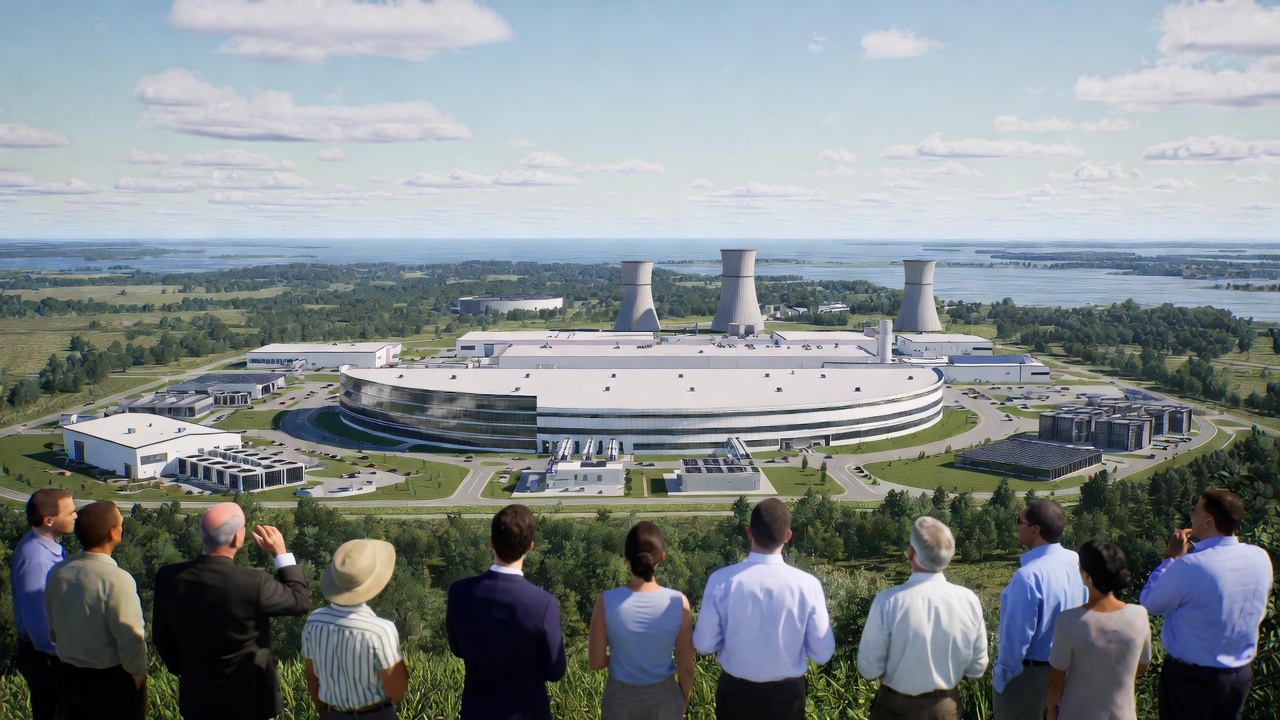
Imagine this: Tech giant Google announces plans to build a massive data center in the Montague Industrial Park, drawn by West Michigan’s abundant freshwater resources from Lake Michigan and its naturally cool climate, which reduces the need for energy-intensive cooling systems. Local leaders buzz with excitement over potential economic growth, while residents voice concerns about water usage, energy demands, and environmental impacts. This scenario isn’t far-fetched. Data centers are proliferating across the U.S. as our digital world expands. But amid the hype and headlines, misconceptions abound. Let’s separate myths from truths, explore what most people overlook, and weigh the pros and cons of such a project right here in our community.
Myths vs. Truths: Clearing the Air on Data Centers
Data centers, those sprawling facilities housing servers that power everything from streaming services to online banking, are often portrayed as resource-guzzling behemoths. While they do have significant footprints, many common beliefs are exaggerated or outdated. Here’s a breakdown of key myths and the realities behind them.
Myth 1: Data centers are destroying local water supplies.
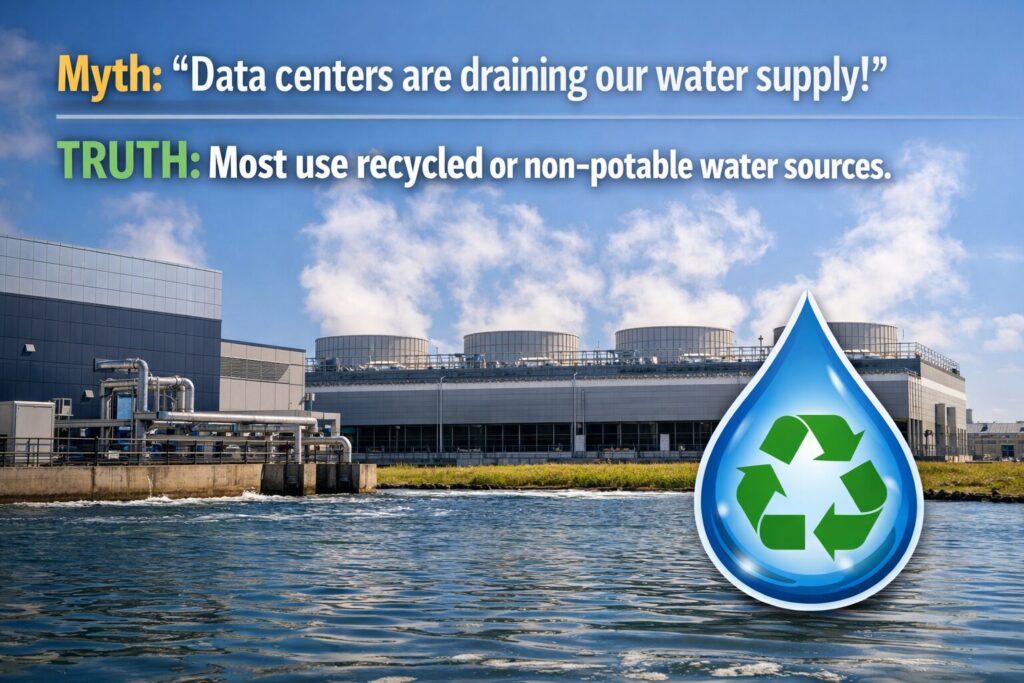
Headlines scream about facilities “drinking” millions of gallons daily, evoking images of parched communities. In truth, while data centers use water for cooling by evaporating it to dissipate heat from servers, modern designs emphasize efficiency. A medium-sized center might consume around 110 million gallons annually, but that’s often from recycled or non-potable sources. In water-rich areas like Michigan, this is less problematic than in drought-prone regions like Arizona. Operators like Google increasingly adopt closed-loop systems that recycle water, reducing net consumption by up to 90% in some cases. What people often miss: indirect water use from electricity generation (for example, cooling power plants) can be larger, but shifting to renewables cuts this dramatically.
Myth 2: Data centers don’t create jobs or benefit local economies.
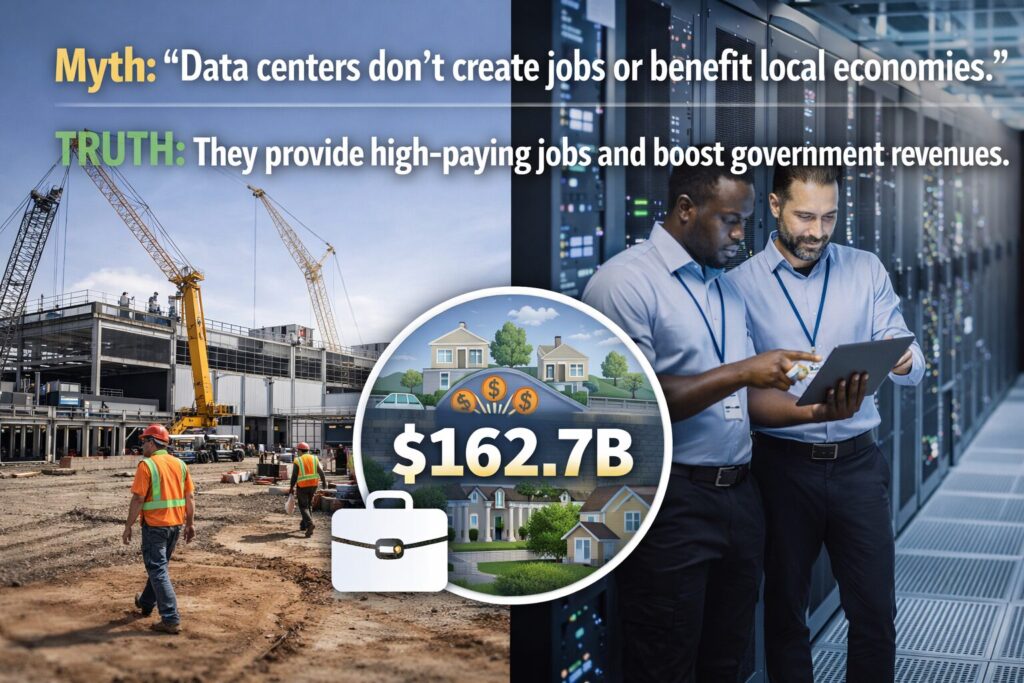
Critics claim these are “jobless boxes” that employ few after construction. Reality check: while ongoing operations might require only 50 to 200 staff per facility, these are high-paying roles in IT, maintenance, and security, often starting above $80,000 annually. Construction phases generate thousands of temporary jobs, and the industry adds a 6X multiplier in indirect employment through suppliers and services. In the U.S., data centers contributed $162.7 billion in government revenues in 2023 alone. An overlooked fact: they attract other businesses by improving local infrastructure, like fiber optics and power grids, fostering a tech ecosystem.
Myth 3: Data centers are just big, empty sheds full of servers.
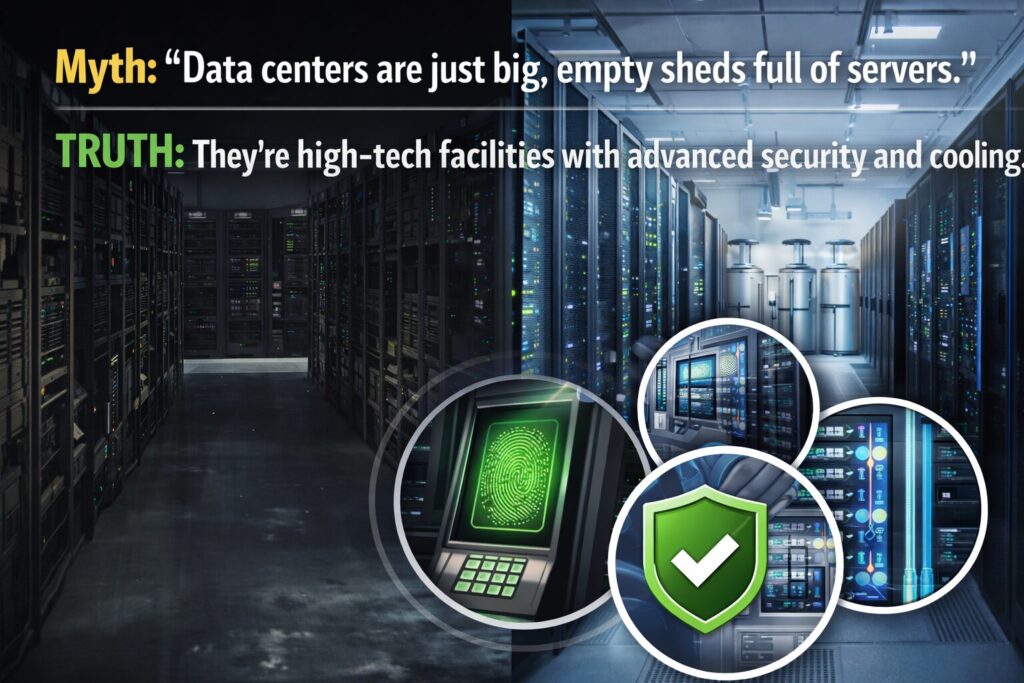
Far from it. These are high-tech hubs with redundant power systems, advanced security, and AI-optimized cooling. They’re engineered for 99.999% uptime, incorporating innovations like liquid cooling to handle AI workloads efficiently. What escapes most: they’re not standalone. They form networks enabling global connectivity, from telemedicine to e-commerce, underpinning our daily lives without us noticing.
Myth 4: They guzzle unlimited electricity, threatening the grid.
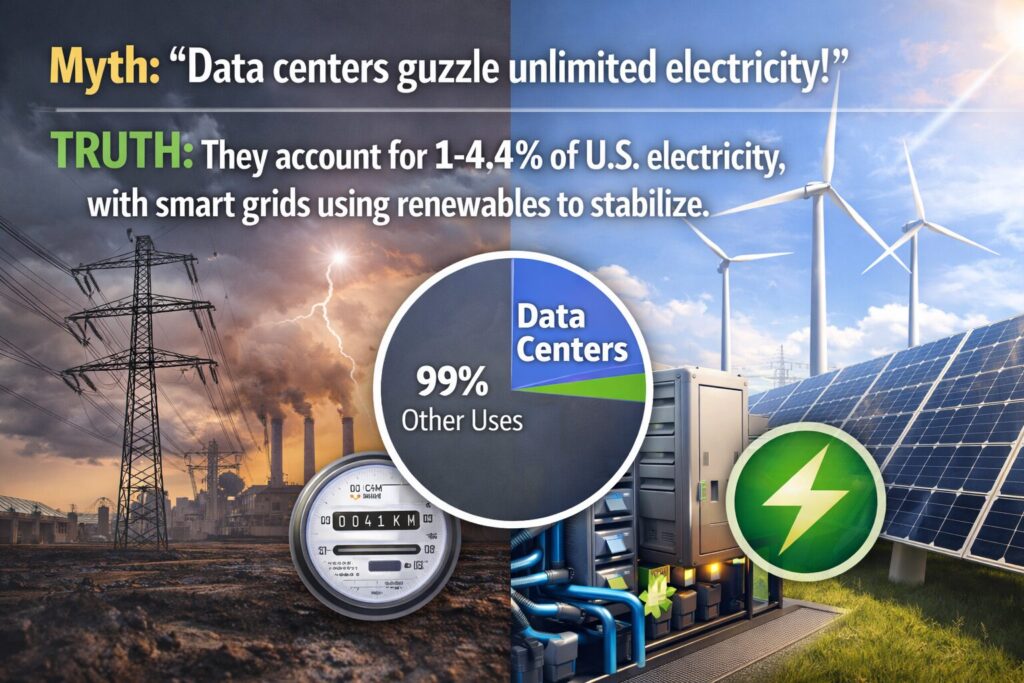
Data centers account for 1 to 4.4% of U.S. electricity, not the apocalyptic surge some fear. Utilities plan interconnections years ahead, and many centers commit to renewables. Google, for instance, matches 100% of its energy with clean sources. A hidden truth: AI-driven centers can fluctuate power use, but smart grids and on-site batteries mitigate instability. In cool climates like ours, natural air cooling slashes energy needs by 40 to 50% compared to warmer sites.
Myth 5: Data centers are noisy, insecure, and environmentally disastrous.
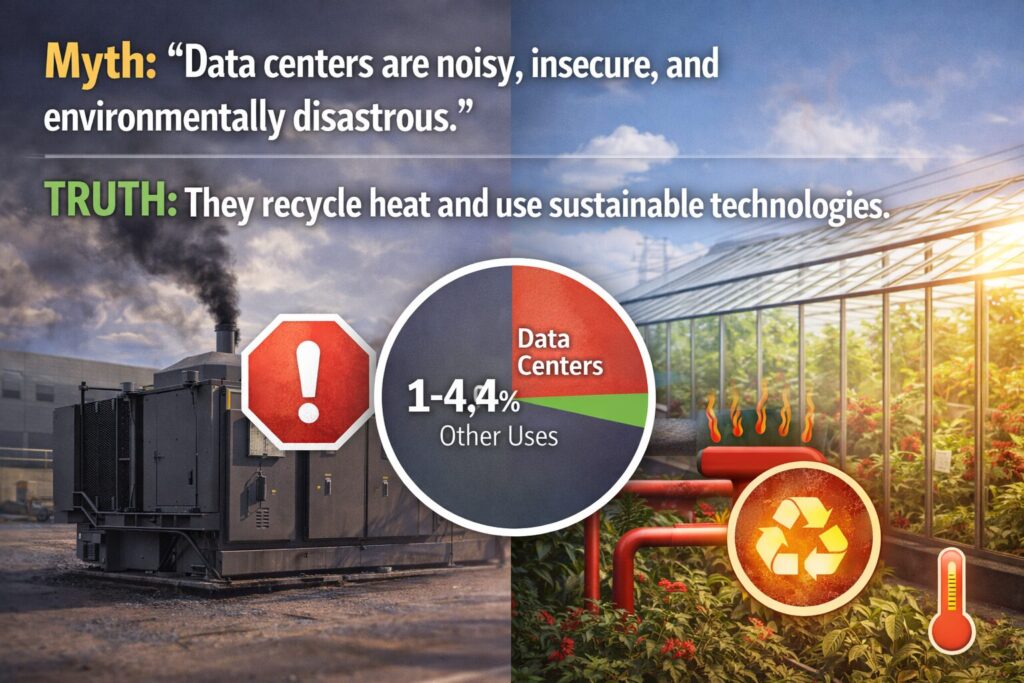
Noise is minimal, equivalent to a commercial AC unit during rare generator tests, and security is fortress-like with biometrics and AI surveillance. On the environment: backup diesel generators emit pollutants, but regulations limit runtime, and many shift to batteries or cleaner fuels. An underappreciated benefit: sustainable designs recycle heat for community uses, like warming greenhouses, turning waste into assets.
What most people don’t understand is the sheer scale of our digital dependency. Every email, social media scroll, or online purchase relies on these centers. They’re not villains but enablers of innovation, from AI diagnostics in healthcare to real-time weather forecasting. Yet their growth demands transparency. Operators often underreport water and energy metrics, leaving communities in the dark.
The Hypothetical Google Data Center: Positives and Negatives for Montague
Back to our scenario: Google’s interest in Montague Industrial Park leverages Lake Michigan’s water and Michigan’s moderate temperatures, ideal for efficient operations. But what would it mean for Whitehall and surrounding areas?
Positives:
- Economic Injection: Construction could create 1,000+ jobs over 2 to 3 years, followed by 100 to 200 permanent positions. Tax revenues might reach millions annually, funding schools, roads, and parks, similar to Loudoun County, Virginia, where data centers generate nearly $900 million yearly.
- Infrastructure Upgrades: Enhanced power grids and broadband could attract more businesses, boosting property values and diversifying the local economy beyond manufacturing.
- Sustainability Wins: In a water-abundant region, Google’s efficient designs (for example, using recycled water) minimize strain, and cool weather reduces energy use by up to 30% compared to warmer sites. Community programs, like heat reuse for agriculture, could emerge.
- Long-Term Appeal: Positioning Montague as a tech hub might draw young talent, reversing population outflows in rural Michigan.
Negatives:
- Resource Strain: Even with abundance, a large center might use 1 to 5 million gallons of water daily, potentially raising utility bills if infrastructure upgrades are needed. Energy demands could spike local rates, as seen in Texas.
- Environmental Concerns: Diesel backups might increase air pollution in nearby areas, exacerbating health issues in vulnerable communities. Land use could disrupt wildlife or aesthetics in the industrial park.
- Limited Jobs and Inequality: Post-construction employment is niche and tech-focused, potentially excluding locals without retraining. Housing costs might rise, pricing out residents.
- Grid and Water Risks: Fluctuating AI loads could stress the grid, and while water is plentiful, climate change might alter long-term availability.
In weighing this hypothetical, community input is key. Zoning, incentives, and environmental reviews could tip the scales, ensuring benefits outweigh drawbacks. Data centers aren’t inherently good or bad; they’re tools of the digital age. For CatchMark, understanding them means engaging thoughtfully, demanding accountability, and seizing opportunities while safeguarding our lakeside way of life. What do you think: boon or burden? Share your thoughts in the comments.
Stay connected to what’s happening in our area by visiting CatchMark Community.
Powered by CatchMark Technologies — helping people, solving problems. Explore more on our website.