When the Forest Funded the Future
Earlier this week on Trivia Tuesday, we asked what industry drove the explosive growth of the White Lake area in the late 1800s.
The answer is the lumber industry.
But the real story is not simply that trees were cut down and shipped away. It is that the forests around White Lake funded the creation of the communities we know today.
Without lumber, Whitehall and Montague might have remained small settlements along the lakeshore. Instead, they became part of one of the most powerful economic engines in Michigan’s early history.
A Lake Built for Lumber
In the mid to late nineteenth century, Michigan’s vast white pine forests were among the most valuable natural resources in the country. Lumber was in high demand as growing cities across the Midwest and Great Plains needed wood to build homes, businesses, railroads, and ships.
White Lake was uniquely positioned to serve that demand.
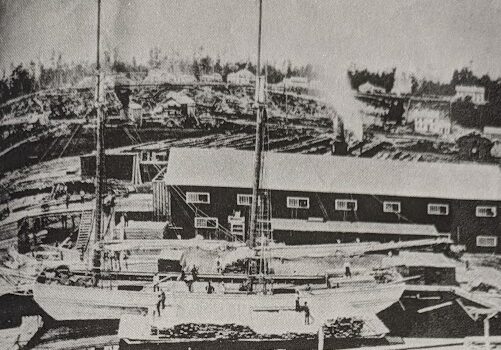
Logs harvested from forests across the region were transported to sawmills along the lake. Once cut into lumber, the boards were loaded onto schooners and shipped out through the channel into Lake Michigan.
At its peak, White Lake’s shoreline was lined with sawmills. Workers, sailors, merchants, and their families filled the growing towns nearby. What had once been quiet shoreline communities became busy centers of industry.

A towering stack of Michigan timber photographed between 1880 and 1899. Photo: Library of Congress.
What Lumber Built
The lumber economy did more than move wood through the region. It created the foundation for community life.
Businesses opened to support mill workers and sailors. Housing expanded. Schools, churches, and public buildings followed. Transportation routes improved as more people arrived looking for opportunity.
The harbor itself became critical infrastructure. Ships moving lumber in and out of White Lake needed reliable access to Lake Michigan, which helped drive projects like the construction of the White Lake channel and the building of the White River Light Station in 1875.
In other words, the forests surrounding White Lake did not just produce lumber. They helped build the entire local economy.
The Turning Point
Like many lumber towns across Michigan, the White Lake area eventually faced a difficult reality. The forests that fueled the boom were not endless.
By the late nineteenth century, much of the region’s original pine had been harvested. As timber supplies declined, many sawmills closed and lumber production slowed dramatically.
For communities that had depended heavily on logging, the transition was not easy. Some towns across Michigan faded when the timber industry disappeared.
Whitehall and Montague took a different path.
Reinventing the Community
Instead of disappearing when the lumber era ended, the White Lake area adapted.
The same harbor that once shipped lumber began supporting new economic activity. Manufacturing, tourism, and recreation gradually became more important. The lake itself became a draw for visitors, boaters, and families looking for the same natural beauty that once attracted lumbermen.
Over time, the identity of the area shifted from extraction to recreation.
But the foundation built during the lumber years remained.
The streets, institutions, and waterfront infrastructure that supported the lumber trade helped shape the community that followed.
Why This Still Matters
It can be easy to think of the lumber era as distant history. The mills are gone and the forests have long since grown back.
Yet the decisions made during that time still shape the White Lake area today.
The harbor exists because ships once carried lumber through it. The communities grew because workers and businesses needed a place to live and trade. Even the sense of local identity is tied to a history of hard work, resilience, and reinvention.
Understanding the lumber industry is not just about looking backward.
It helps explain how a lakeshore community built on timber survived the end of the timber era and found new ways to thrive.
That is the deeper story behind this week’s trivia.
The forests may have funded the beginning, but the community that grew here wrote the next chapter.
Stay connected to what’s happening in our area by visiting CatchMark Community.
Powered by CatchMark Technologies — helping people, solving problems. Explore more on our website.