Over the years, I have had the opportunity to serve on and work alongside a number of civic boards. From school boards to community organizations, these roles have provided a front-row seat to how decisions are made and how leadership shapes outcomes at the local level. In addition to direct involvement, our work through CatchMark Community has given us an even broader perspective. We make it a priority to attend, observe, and listen to nearly every public board meeting in our area.
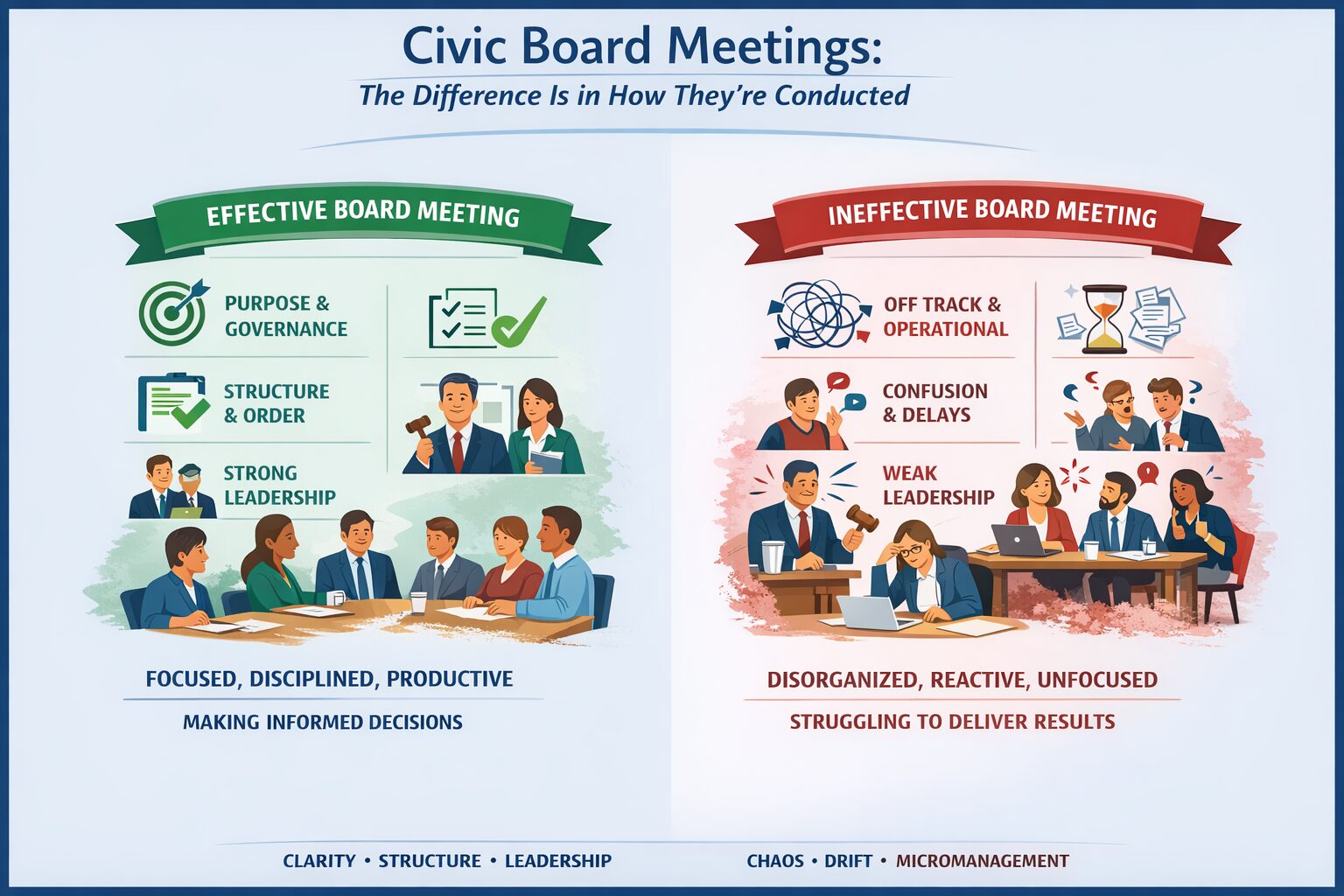
That level of exposure reveals a clear truth. Not all board meetings are created equal. Some are disciplined, productive, and focused. Others lack structure, drift off course, and struggle to deliver results. The difference is rarely about intelligence or intent. It is about how the meeting is conducted.
Purpose Comes First
At its core, a well-run civic board meeting is grounded in purpose. The role of a board is governance, not management. Meetings should exist to guide direction, establish policy, and make informed decisions that align with the mission of the organization. When meetings drift into operational detail or become reactive, they lose their effectiveness and their value to the community.
Structure Builds Trust

Structure is the first visible sign of a healthy board. Effective meetings follow a clear and predictable flow. They begin with formalities such as calling the meeting to order and confirming quorum, and then move through agenda approval, reports, discussion, and action.
This structure is not about rigidity. It is about creating consistency so that board members, staff, and the public understand how business will be conducted. Predictability builds trust, and trust is essential in any public setting.
Leadership at the Table: The Role of the Chair, President, or Mayor
Every effective meeting depends on strong facilitation. Whether the role is titled board president, chair, or mayor, this individual sets the tone for the meeting.
The chair is responsible for guiding the agenda, maintaining order, and ensuring the meeting stays focused on its purpose. This includes recognizing speakers, managing time, and keeping discussion aligned with the topic at hand. A strong chair balances efficiency with inclusion, making sure all board members have the opportunity to contribute without allowing the meeting to be dominated by any one voice.
Equally important, the chair protects the integrity of the process. This means ensuring motions are handled correctly, votes are clear, and decorum is maintained, especially during moments of disagreement or public tension. The best chairs are not the loudest voices in the room. They are the most disciplined facilitators.
The Operational Voice: The Role of the Executive
Alongside the board sits the executive leader. This may be a city manager, superintendent, or executive director, depending on the organization. While the board governs, the executive leads operations.
The executive’s role in a board meeting is to provide accurate information, professional recommendations, and operational context. They help translate strategy into execution and ensure the board has the data needed to make informed decisions. However, they do not make the decisions themselves. That responsibility rests with the board.
A strong relationship between the board and the executive is critical. The board sets direction and expectations. The executive carries them out. When those roles are respected and clearly understood, meetings become more productive and outcomes more consistent.
Staying at the Right Altitude
Another key principle is staying at the right altitude. High-performing boards understand that their role is governance, not operations. They are responsible for setting direction, establishing policy, and providing oversight. They are not responsible for running the day-to-day functions of the organization.
Operational responsibility belongs to the executive leader, whether that is a city manager, superintendent, or executive director. These individuals are accountable for execution, managing staff, and carrying out the direction set by the board.
When boards cross into operations, even with good intent, it creates confusion, slows progress, and undermines leadership. It can erode accountability by blurring who is actually responsible for results.
This often shows up in subtle but important ways. Boards begin discussing individual employee performance rather than organizational outcomes. They weigh in on which vendor to select instead of ensuring procurement policies are followed. They get involved in how a project is executed, where something should be placed, or how a process should flow through a department. In some cases, board members may even attempt to direct staff outside of the executive’s authority or respond to individual citizen complaints as if they are part of the service team.
These are all signs of a board operating at the wrong level.
Strong boards redirect these conversations. Instead of focusing on who is doing the work or how it is being done, they focus on what outcomes are expected and whether leadership is delivering results. They hold the executive accountable, rather than stepping in to do the work themselves.
Clarity in these roles is essential. The board governs. The executive operates. When that distinction is respected, organizations function more effectively and decisions are carried out with greater consistency.
The Power of the Consent Agenda
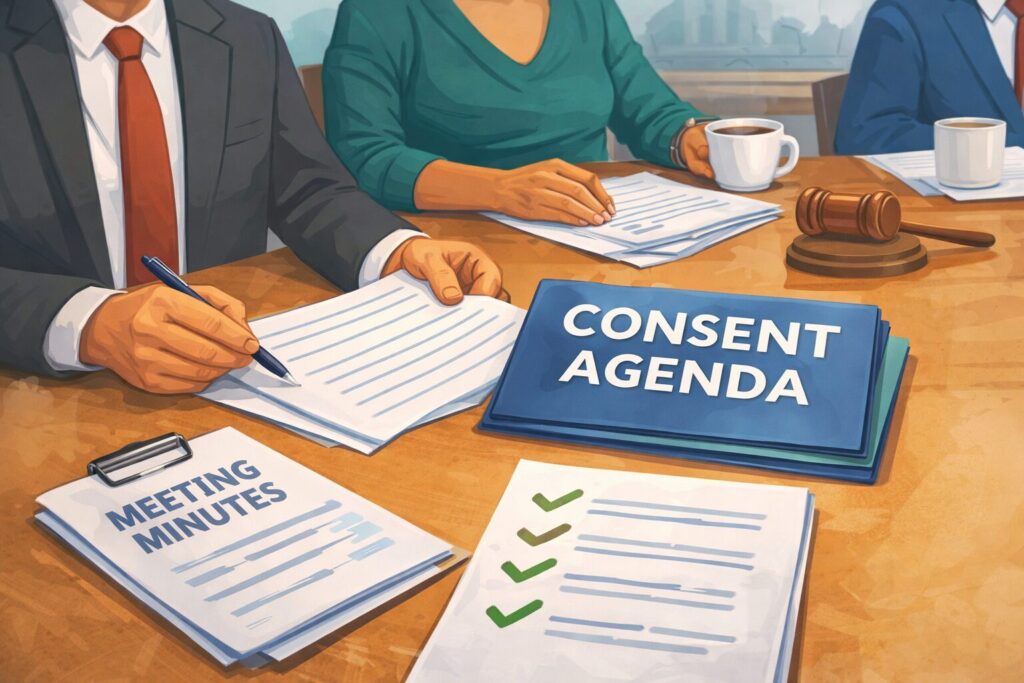
Within the board structure, one of the most underutilized but powerful tools is the consent agenda. A consent agenda groups routine, non-controversial items into a single motion and vote. Items such as prior meeting minutes, standard reports, and routine approvals can be handled efficiently without consuming valuable meeting time.
The purpose is simple. Protect time for what matters most. A strong board understands that its most valuable asset is not time spent talking, but time spent thinking and deciding. The consent agenda creates space for meaningful discussion by removing unnecessary repetition. At the same time, it preserves transparency by allowing any board member to pull an item for separate consideration.
There is also an important signal embedded in how the consent agenda is used. If a board consistently finds itself spending significant time asking questions about items within the consent agenda, something is broken. This may be operational, such as information not being communicated clearly in advance, a lack of trust in the executive, or underlying processes not functioning as they should. It may also reflect a lack of board member discipline, where members are not preparing ahead of time, or weak meeting control from the board leader, where the chair is not holding the line on what belongs in consent versus full discussion.
Well-functioning organizations handle routine matters routinely. When that is not happening, the issue is not the agenda. It is the system, and the discipline, behind it.
Discipline Drives Effectiveness
Discipline is what separates an average meeting from an effective one. This begins before the meeting ever starts. Board members should come prepared, having reviewed materials in advance. Meetings should not be used to read reports for the first time. They should be used to ask questions, challenge assumptions, and make decisions.
Well-prepared boards take this a step further. Questions, especially clarifying or informational ones, should be asked and answered in advance whenever possible. This allows meeting time to be reserved for higher-value discussion, not basic information gathering. When a meeting is consumed by questions that could have been handled beforehand, it is a sign that preparation and communication need to improve.
Discipline also shows up in how the meeting is facilitated. A strong chair keeps the group aligned with the agenda, manages time appropriately, and ensures that all voices can be heard without allowing any one voice to dominate. Conversations should remain focused on issues, not personalities. Respectful disagreement is not only healthy, it is necessary for good governance. However, it must be directed toward better understanding and better outcomes.
A Commitment to Improvement
Finally, the best boards are willing to improve. They periodically reflect on how meetings are conducted and look for ways to become more effective. This might involve refining the agenda structure, improving pre-meeting communication, or simply holding each other accountable to the standards they have set.
Final Thoughts
A civic board meeting is more than a procedural requirement. It is a public demonstration of leadership. From both personal involvement and our broader observation through CatchMark Community, one thing is clear. Communities benefit when boards operate with clarity, discipline, and intention.
When roles are clearly defined, when leadership facilitates rather than dominates, and when executives provide strong operational partnership, meetings become significantly more effective. Combined with structure, discipline, and tools like the consent agenda, these elements create an environment where good decisions can consistently be made.
Good governance is not complicated, but it does require consistency. When boards commit to doing the basics well, their meetings become more than just gatherings. They become vehicles for meaningful progress.
Stay connected to what’s happening in our area by visiting CatchMark Community.
Powered by CatchMark Technologies — helping people, solving problems. Explore more on our website.