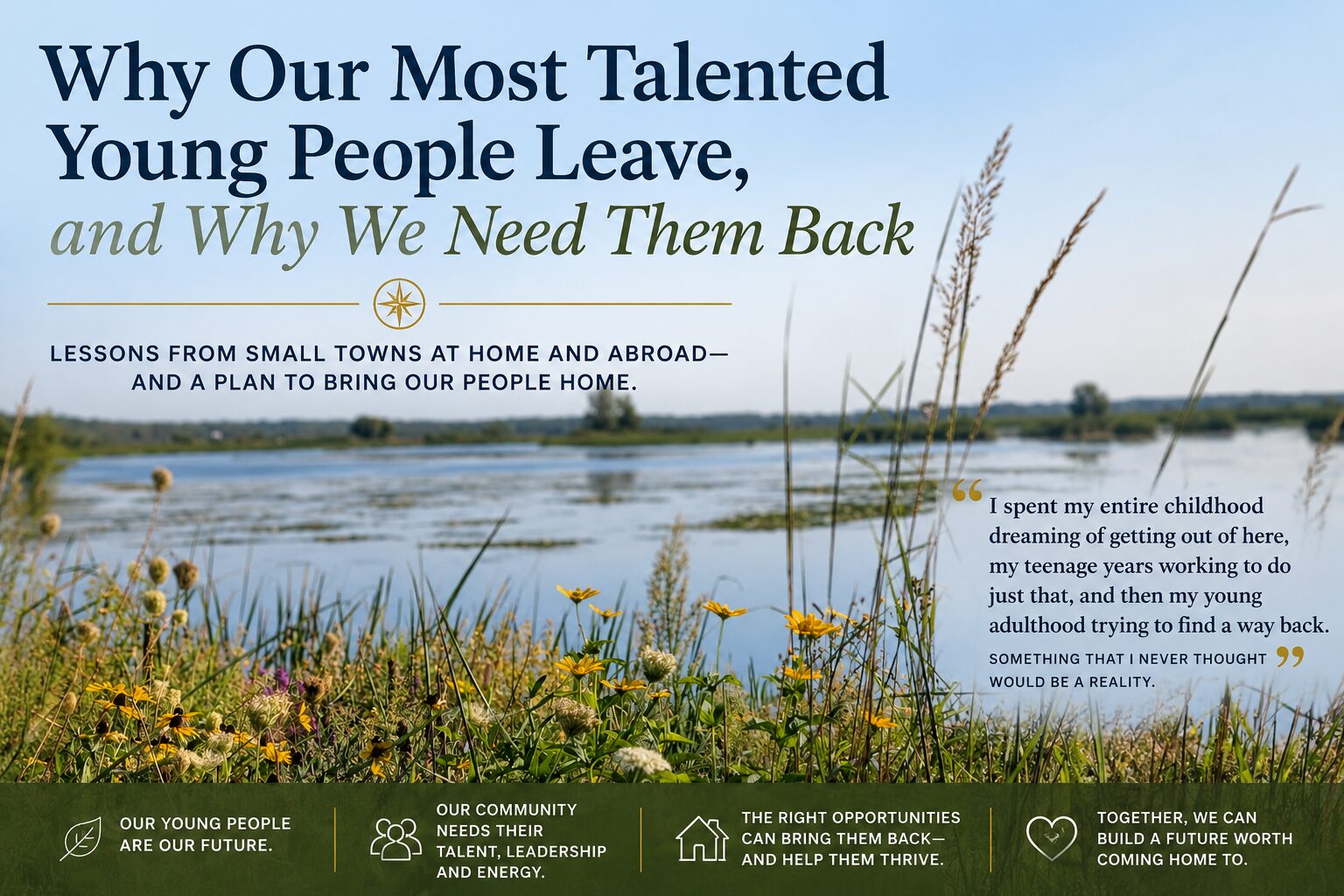
Like many young people, I spent my entire childhood dreaming of getting out of here, my teenage years working to do just that, and then my young adulthood trying to find a way back.
For a long time, coming back did not feel realistic. I never thought it would become a reality. Like many young people raised in communities like Montague and Whitehall, I loved where I came from, but I did not always see a future here.
That is the challenge we need to face honestly. Our young people are not leaving because they lack loyalty. Many leave because they are ambitious, capable, and looking for opportunity. The real question is whether we are building a community where they can come back and thrive.
In communities like Montague and Whitehall, we take pride in raising good kids. They grow up with strong values, supportive families, and a sense of connection that is hard to replicate elsewhere. We invest in them through our schools, churches, teams, and community organizations. Then, all too often, they leave.
This is not unique to us. It is happening across small towns throughout America and increasingly across Europe as well. Rural villages in Italy, Spain, Germany, and Eastern Europe are facing shrinking populations, aging communities, school closures, workforce shortages, and declining local economies. Many of those towns once assumed their traditions and way of life would naturally continue into the next generation. Instead, they are now fighting to survive.
The lesson is clear. Communities do not decline all at once. They slowly lose momentum when their young, talented, and ambitious people leave and never come back. This is not about blaming young people. They are making rational decisions based on opportunity. But it is about recognizing what happens to a community when too many of its future builders, leaders, entrepreneurs, teachers, and families settle somewhere else permanently.
Opportunity Drives Movement
Talented young people are naturally ambitious. They want to grow, build, and test themselves. Larger cities often offer:
- More diverse career paths
- Higher earning potential
- Access to specialized industries
- Broader professional networks
For someone pursuing careers in technology, engineering, healthcare, finance, media, or the creative industries, small towns can feel limiting, even when they love where they grew up.
And today’s young people are more connected than ever. Through the internet, college, internships, and travel, they are exposed to a much larger world. Their expectations are shaped not only by what exists locally, but by what they know is possible elsewhere.
The problem is not ambition. The problem is when communities fail to create a compelling reason to return.
Why This Matters More Than We Think
When communities lose talented young adults consistently over time, the impact compounds. You do not just lose population. You lose:
- Future business owners
- Volunteers and civic leaders
- Young families and future students
- Skilled professionals
- Innovation and entrepreneurship
Eventually, communities begin to age faster than they replenish themselves. This is exactly what many European small towns are struggling with today. Schools close because enrollment drops. Main streets weaken because there are fewer working-age families. Employers struggle to hire. Healthcare systems strain under aging populations. Volunteer organizations shrink. Economic growth slows.
The reality is simple. Small towns cannot thrive long term without attracting and retaining the next generation.
The Hidden Cost of Losing Talent
The most dangerous part of this trend is that decline often feels gradual and manageable at first. A few students leave for college. A few families relocate for work. A few businesses struggle to find successors. But over twenty or thirty years, the effects become structural. Communities begin to lose:
- Economic energy
- Leadership capacity
- Entrepreneurial risk-takers
- Cultural vibrancy
- Long-term sustainability
At some point, communities stop talking about growth and start talking about preservation. That is not the future communities like Montague and Whitehall should accept.
Many Would Come Back if We Created the Right Conditions
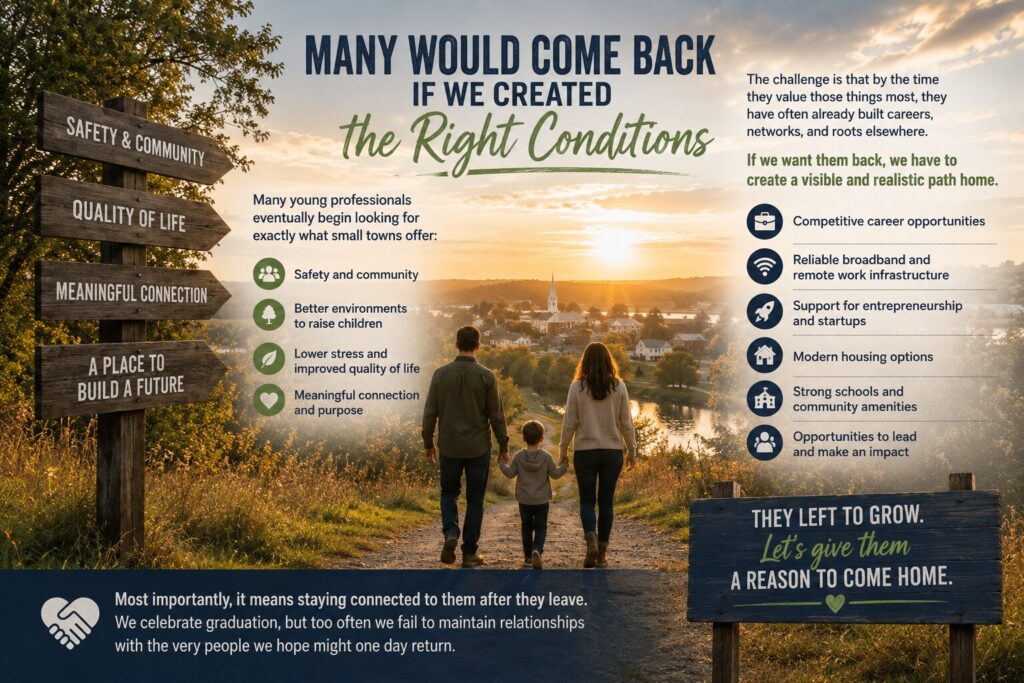
One of the biggest misconceptions is that once young people leave, they are gone forever. That is often not true. Many young professionals eventually begin looking for exactly what small towns offer:
- Safety and community
- Better environments to raise children
- Lower stress and improved quality of life
- Meaningful connection and purpose
The challenge is that by the time they value those things most, they have often already built careers, networks, and roots elsewhere. If we want them back, we have to create a visible and realistic path home. That means:
- Competitive career opportunities
- Reliable broadband and remote work infrastructure
- Support for entrepreneurship and startups
- Modern housing options
- Strong schools and community amenities
- Opportunities to lead and make an impact
Most importantly, it means staying connected to them after they leave. We celebrate graduation, but too often we fail to maintain relationships with the very people we hope might one day return.
We Need a Return Strategy, Not Just a Retention Strategy
Not every young person should stay immediately after graduation. In many cases, leaving is healthy. It exposes people to new ideas, experiences, and skills. The goal should not be isolation. It should be circulation. Small towns benefit when young adults:
- Gain experience elsewhere
- Build professional expertise
- Expand their perspectives
- Then bring those experiences back home
But that only happens intentionally. Communities need to actively:
- Stay connected with graduates
- Promote local opportunities
- Encourage mentorship and networking
- Invite young professionals into leadership roles
- Create pathways for returning families and entrepreneurs
The communities that succeed in the next twenty years will not necessarily be the biggest. They will be the ones that become magnets for talent, purpose, and quality of life.
The Future Is Still Ours to Shape
Montague and Whitehall already possess many things people across the country are searching for:
- Strong community
- Natural beauty
- Safety
- Authenticity
- A sense of belonging

Those are not small advantages. In many ways, they are becoming more valuable, not less. But quality of life alone is not enough. Opportunity must exist alongside it.
If we want a different future, we cannot simply hope young people stay. We must build communities where talented people can realistically succeed, contribute, and envision a future for themselves and their families.
Our young people are not leaving because they do not care about this community. Many of them care deeply. The real question is whether we are creating enough reasons, opportunities, and vision to bring them home again.
Follow along on social media for daily updates, community highlights, and moments that happen between the headlines.
Facebook • Instagram • YouTube • TikTok • LinkedIn • X
Stay connected to what’s happening in our area by visiting CatchMark Community.
Powered by CatchMark Technologies — helping people, solving problems. Explore more on our website.